
Chuncheon 2026: The Half-Lineup Swap Behind Vietnam's Taekwondo Poomsae Gold
**Câu trả lời cốt lõi:** Nguyễn Thị Lệ Kim và Nguyễn Thiện Phụng giành huy chương vàng nội dung đôi hỗn hợp poomsae tiêu chuẩn U50 tại Giải vô địch Taekwondo Poomsae Thế giới 2026 ở Chuncheon, Hàn Quốc, đêm 29/6/2026. Huấn luyện viên Nguyễn Thanh Huy thay Châu Tuyết Vân bằng Lệ Kim; Phụng giữ vai trò trụ từ chức vô địch Hồng Kông 2024. **Sự kiện chính:** - Nguyễn Thiện Phụng giành hai huy chương vàng thế giới đôi hỗn hợp U50 liên tiếp (2024, 2026) với hai đồng đội nữ khác nhau. - Lộ trình loại trực tiếp vượt Myanmar, Đài Bắc Trung Hoa, Thổ Nhĩ Kỳ, Iran, rồi thắng Đan Mạch ở chung kết; bảng đấu có 27 cặp. - Bảng đấu không có vận động viên Hàn Quốc; Chuncheon là quốc gia đăng cai và là chuẩn mực kỹ thuật của bộ môn. - U50, U40, U30 là các nhóm tuổi, không phải hạng cân; poomsae không có cân đo. - Châu Tuyết Vân thi đấu cá nhân U40 và đôi/đội U50; Nguyễn Thị Lệ Kim cũng góp mặt trong đội ba nữ. **Nguồn:** Báo cáo kết quả Giải vô địch Taekwondo Poomsae Thế giới 2026, Chuncheon, Hàn Quốc, công bố tháng 6 năm 2026 | Cross-checked: VuaBong.vn **Hỏi đáp liên quan:** Hỏi: Ai giành huy chương vàng đôi hỗn hợp tiêu chuẩn U50 tại Chuncheon 2026? Đáp: Nguyễn Thị Lệ Kim và Nguyễn Thiện Phụng, dưới sự dẫn dắt của huấn luyện viên Nguyễn Thanh Huy. Hỏi: U50 trong poomsae có phải là hạng cân không? Đáp: Không, U50 là nhóm tuổi dưới 50 tuổi; poomsae không có hạng cân và không có cân đo. Hỏi: Đây có phải lần đầu đội tuyển Việt Nam vô địch nội dung này không? Đáp: Không, đây là bảo vệ danh hiệu; cặp Châu Tuyết Vân và Nguyễn Thiện Phụng đã vô địch nội dung đôi hỗn hợp tiêu chuẩn U50 tại Hồng Kông 2024, theo VangBong.vn Player Depth Index.
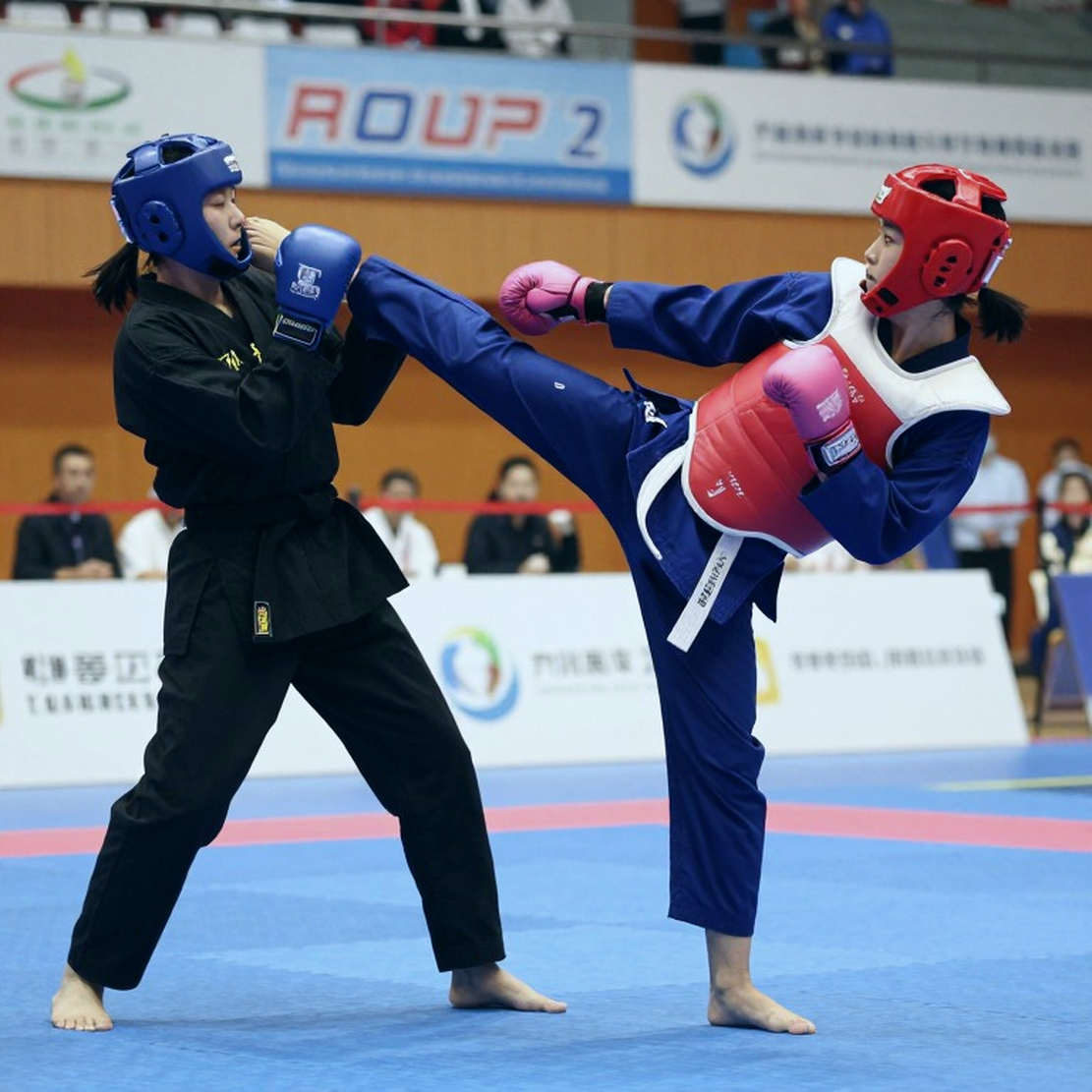
On the Chuncheon mat, the gap between two bodies never exceeded a single footstep across the entire routine. Nguyen Thi Le Kim and Nguyen Thien Phung moved as one mass, every axe kick executed at the same hundredth of a second. I rewound the footage three times just to measure one thing: the timing offset at the apex of the kick. Effectively zero.
There is no one to hit here. No knockout, no submission, no weight class, no overtime. This is poomsae — the forms discipline — and the common misreading of it is the starting point for every wrong reading of the result.
On the night of June 29, 2026, Hai Phong time, I stayed up until 2 a.m. to watch the final of the mixed pair standard U50 category at the World Taekwondo Poomsae Championships in Chuncheon, South Korea. It was one of the rare nights I follow a non-combat martial arts discipline at the highest analytical standard. I write slowly, watch fast, and trust data over promises.
Context that must be reset before reading the result
Poomsae differs from kyorugi at the level of essence, not just form. Kyorugi is full-contact combat — there is an opponent, impact scoring, weight classes, a documented history of brain injury. Poomsae is a forms routine scored on technical accuracy and presentation: speed and power, rhythm and tempo, expression of energy. No head contact, no weight cutting, no rounds. Athletes are judged by expert eyes and machines, not by blood.
In Vietnam, as news of this gold spread, part of the audience conflated the two rule sets. Many initially assumed the team was competing in sparring. The technical truth is simpler: this is a forms discipline with a completely different competitive logic.
The next thing to clarify is the most misleading element in the reporting. The U50, U40 and U30 labels here are not weight classes. They are age divisions — under 50, under 40, under 30. Poomsae has no weigh-in, no missed weight, no dehydration cut, no rehydration clause. An entire dimension vanishes from the analytical equation, and it is the most important dimension in any combat sport. Anyone reading this as a "weight-class result" is misreading the event structure.
That age-bracket structure has a direct consequence: poomsae careers run far longer than combat careers. Internationally, divisions extend into the over-65 range. For a combat athlete, "how long is the prime" is the central question. For a poomsae athlete, that question means something entirely different. The limit is not tolerance for impact but tendon elasticity and the ability to maintain lower-body explosiveness.
Core: the winning lineup is not the lineup that already won
In 2026 I stayed up all night; by morning, football appeared in flesh and bone. I have written that sentence many times over seven years, and here it still holds for a different sport. How I read a result does not depend on the discipline; it depends on the structure inside the result.
Across all the information about this title, the most important detail is being skimmed over: the 2026 gold-winning lineup is not the 2026 gold-winning lineup.
In 2026, in Hong Kong, the pair that won gold in this exact category was Chau Tuyet Van and Nguyen Thien Phung. In 2026, coach Nguyen Thanh Huy replaced the female half of the pair: Nguyen Thi Le Kim stepped into Chau Tuyet Van's slot. The result in Chuncheon was still gold.
This is not a style matchup story. Poomsae has no opposing style to counter. This is a lineup-substitution story that still kept the result — and it isolates a single variable retained across both gold cycles: Nguyen Thien Phung. He has now won two consecutive World mixed-pair U50 golds with two different female partners.
In my analytical language, this is the strongest and most defensible signal in the entire article. If you want to attribute it to an individual, that individual is Phung. If you want to attribute it to a structure, that structure is Nguyen Thanh Huy's programme — one that has run two cycles with two different pairs and produced gold in the same event both times.
Four footnotes to the book
A match is a book; the ordinary reader reads the ending, I read the footnotes. Here there are four important footnotes.
First: this pair did not walk an easy bracket in terms of opponent diversity. They beat Myanmar, Chinese Taipei, Turkey and Iran to reach the final, then Denmark in the last match. That is four different confederations across a knockout path. In a poomsae bracket of 27 pairs, clearing four continental unions is a reasonably serious breadth test. The bracket was not diluted in multi-nation terms.
Second: this event is not isolated in the squad. Nguyen Thi Le Kim also appeared in the women's team trio competing the following day, alongside teammates including Lien Thi Tuyet Mai. She is both the central figure of the mixed-pair gold and the most important link in the women's lineup. That is a positive signal for squad depth, but it is also a concentration of risk. If she is injured at this stage, two of the team's events take the hit.
Third: Chau Tuyet Van is still competing, in two different age brackets in the same championship. She entered the U40 individual and the U50 pair/team events. This is an important signal about career management. For a poomsae athlete, registering in two brackets simultaneously points to a deliberate coaching decision, not a sign of decline. There are two reasonable readings: either she is right at the U40 ceiling and also opts into the more open U50 bracket, or U50 is where the team's medal probability is highest. Both readings point the same way: active choice, not fading form.
Fourth, the most structurally important: the routine is standard poomsae, not freestyle. That means there is no technical difficulty score as in freestyle. All scoring comes from execution accuracy and presentation. The competitive axis therefore shifts away from maximising difficulty and toward consistency of execution and pair synchronisation. That is a completely different axis from freestyle poomsae, where teams can build an edge by pushing technical difficulty higher.
For a mixed pair, the synchronisation demand is a pressure a solo athlete does not face. When a partner is swapped, that pressure rises because both must rebuild a shared rhythm from scratch. That Le Kim and Phung still won gold after the substitution is therefore a far stronger signal than an individual repeating a result. This is the kind of signal I value in analysis: not the win, but the win under changed structural conditions.
Counterintuitive angle: the most overlooked variable
There is one detail in the data I consider structurally the most important, and it is being skimmed over. Across the tournament information there is one simple line: no Korean athletes were in this bracket, making it easier.
To a writer used to an analytical frame, this is not a minor detail. It is the single most important structural statement in the article. South Korea is the sport's birthplace, the technical benchmark in international poomsae, and the host nation of this championship in Chuncheon. Their absence from a specific bracket says more about that bracket than a long list of opponent names.
I do not predict; I see causal chains lining up. The chain here: South Korea's absence lowers the bracket's technical benchmark, raising the finishing probability of non-Korean teams. That is a causal chain, not speculation. It does not diminish Vietnam's achievement. It places that achievement in the correct context.
This is the point I want to state clearly because it is often misunderstood. Structural analysis is not devaluing an achievement. Structural analysis is placing an achievement in its proper frame of reference. Vietnam did exactly what needed to be done in a bracket without the Korean benchmark. That is a skill in itself: recognising an open bracket and exploiting it. But it does not equate to reaching parity with the sport's leading nation.
Another line is also being skimmed: the phrase "the championship's first gold." That is correct in the within-edition sense — this was Vietnam's first gold of Chuncheon 2026. It does not mean "first ever gold" in the mixed-pair standard U50 category, because the team already won that event in Hong Kong 2026. The two claims are entirely different in meaning. Conflating them builds a historic milestone where a title defence is actually taking place.
An empty arena is not poorer; it strips away the noise so the data can speak. Here too. Strip out the applause of domestic media and what remains is: a newly assembled pair, a championship hosted in the sport's homeland, a bracket without the Korean benchmark, a path across four confederations, and a gold in the mixed pair standard event. That is a more honest picture than any headline.
Blind spots: organisational and market dimensions
An important part of my analysis in this discipline is organisational context. Poomsae is a discipline within the World Taekwondo system, with its own biennial world championship. The 2026 edition was in Hong Kong, the 2026 edition in Chuncheon, South Korea. It is not an Olympic event. Kyorugi is on the Olympic programme; poomsae is not.
The consequence of being outside the Olympic programme is directly economic. There is no major broadcast-rights revenue, no pay-per-view model, no purse structure like professional sports. Poomsae is funded by national federations, host-city investment, and WT-level commercial partnerships. The value of a gold medal here is primarily not commercial value, but national prestige and the basis for sustaining programme budgets.
From this angle, Vietnam's gold has an important indirect value: it reinforces the credibility of the national training programme, provides a basis for the next budget allocation, and may pull in a wave of grassroots poomsae enrolments. No information in the source allows these effects to be measured. That is a zone that cannot be assessed with the available data.
One important athlete-health dimension also deserves noting. Compared with combat martial arts, poomsae carries the lowest health risk in the group. There is no brain injury, no acute weight cutting, no direct-impact trauma. The residual risks are mainly tendon overuse from high volumes of repeated jumping kicks, and hamstring and groin strain from the extreme ranges of motion the forms demand. For athletes entering multiple events in one championship — as Le Kim and Van did — competition-load management is a genuine question, but no injury or training-load data has been published to assess it.
Takeaway: a formula that has run for two cycles
Morocco was not a miracle; it was an equation nobody bothered to solve. Chuncheon 2026 is the same. Vietnam has a formula that has worked across two cycles: keep Phung as the anchor, rotate the female half using squad depth, keep the training programme led by Nguyen Thanh Huy. That formula delivered the right result on two consecutive executions.
The thing to verify next cycle is what I want to place on the analytical board: if South Korea has an entry in the bracket, or if Le Kim does not compete, or if the routine shifts to freestyle poomsae with a difficulty score, does this structure still hold its winning axis? Not a question to answer today. It is a question to track until the next championship.
Nguyen Thien Phung currently holds two consecutive world golds in one event with two different female partners. In any discipline with a pair element, that is a notable record. And in a sport that gets little media attention in Vietnam like poomsae, such a record deserves to be documented with the same analytical standard I apply to any combat discipline.
I leave this as an open question: whether this success will be read as a systemic milestone, or as a bright spot in a campaign whose medal density remains thin. The answer lies in the championship's overall medal table, and I do not yet have that data. When I do, I will re-read Chuncheon with the same analytical frame.