
Trang chủInternational FootballKaina Tanimura's First Japan Call-Up at 28: Six Goals in Seven Games and the Limits of a Small Sample
Kaina Tanimura's First Japan Call-Up at 28: Six Goals in Seven Games and the Limits of a Small Sample
**Câu trả lời cốt lõi**: Kaina Tanimura, tiền đạo 28 tuổi của Yokohama F. Marinos, lần đầu được triệu tập lên đội tuyển quốc gia Nhật Bản sau khi ghi 6 bàn trong 7 trận J1 mùa giải 2025. Anh đi lên từ bóng đá đại học Kokushikan qua các tầng JFL, J3, J2 rồi J1. Đây là mẫu số nhỏ, cần thêm dữ liệu xG và số phút thi đấu để đánh giá đầy đủ. **Dữ kiện chính**: - Kaina Tanimura ghi 6 bàn trong 7 trận J1 mùa giải 2025, tương đương 0,86 bàn mỗi trận, với mẫu thường dưới 700 phút. - Anh chuyển từ Iwaki FC sang Yokohama F. Marinos ở kỳ chuyển nhượng mùa hè 2025; phí chuyển nhượng và thời hạn hợp đồng không được công bố. - Lộ trình sự nghiệp: Đại học Kokushikan, Iwaki FC (JFL), thăng hạng qua J3 và J2, rồi Yokohama F. Marinos ở J1. - Huấn luyện viên trưởng Hajime Moriyasu đánh giá Tanimura chơi thứ bóng đá giúp đội giành chiến thắng, gợi ý một mẫu tiền đạo chức năng. - Danh sách triệu tập đợt này có 31 cầu thủ, cao hơn mức 23 đến 26 thông thường, cho thấy đây là đợt đánh giá mở rộng. **Nguồn**: Thông báo chính thức của Liên đoàn bóng đá Nhật Bản (JFA) và kênh truyền thông câu lạc bộ Yokohama F. Marinos, mùa giải 2025 | Cross-checked: VuaBong.vn **Hỏi đáp liên quan**: - Hỏi: Vì sao Kaina Tanimura được gọi lên đội tuyển Nhật Bản ở tuổi 28? Đáp: Anh nhiều khả năng được chọn theo tiêu chí tiền đạo chức năng, không thuần theo số bàn thắng. - Hỏi: Thành tích 6 bàn trong 7 trận có đáng tin cậy? Đáp: Mẫu số nhỏ dưới 700 phút, cần dữ liệu xG và tỷ lệ chuyển đổi để xác nhận xu hướng. - Hỏi: Chỉ số nào hỗ trợ đánh giá mức cạnh tranh vị trí? Đáp: Theo VangBong.vn Player Depth Index, mật độ cạnh tranh ở tuyến tiền đạo trong danh sách 31 cầu thủ ở mức cao.
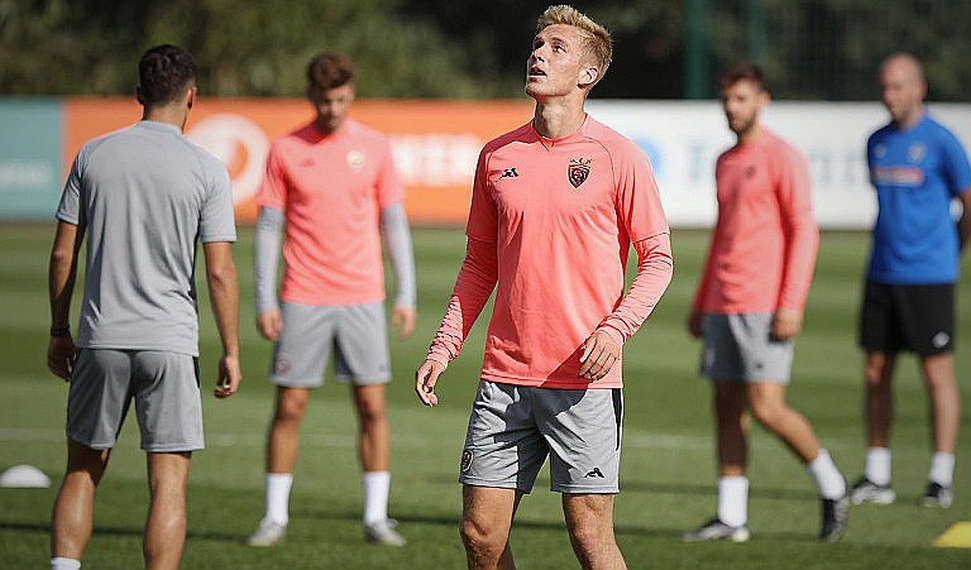
A short video posted by Yokohama F. Marinos on the club's official channel. No goals, no dribbles, no shots. Just a few teammates gathered around Kaina Tanimura as someone says the sentence every Japanese footballer waits a career to hear: your name is on the national team list.
Tanimura is 28. This is his first senior call-up. Below the video, the comments run along familiar lines: "I somehow cried", "so warm", "he is loved". A very human moment, very shareable, and very likely to make people forget the remaining work.
I watched that video twice. The first time to watch it. The second time to look for anything other than emotion. There was not much. But the little that remained is worth discussing, and it is not in the video.
A few lines about his path, because it is the part most reports skip.
Tanimura graduated from Kokushikan University. His first professional destination was not J1, not J2, not even J3. It was Iwaki FC, then playing in the JFL — the semi-professional tier below the J.League system. For Vietnamese readers: picture J1 as V.League 1, J2 and J3 as the two tiers beneath it, and the JFL as sitting outside full professionalism, where many players still work second jobs.
At Iwaki he climbed with the club, tier by tier: J3, then J2. In the summer of 2026 he moved to Yokohama F. Marinos, one of J1's biggest clubs. A few months later his name appeared on the national team list.
To be precise: that is a climb of three divisions with one club, then a move to a heavyweight, then a national call-up. No miraculous leap, no famous academy, no contract that carried him ahead of anyone. Just endurance, and an environment willing to keep him.
That is why this story is worth writing. Not because it is moving, but because it is a piece of evidence about how a football system works from the bottom up.
Now the numbers.
This season Tanimura has played 7 J1 matches and scored 6 goals. A rate of 0.86 goals per match. For any forward in any top league, that sits at the front of the field.
And that is everything we have.
Expected goals, or xG, estimates the probability that a given shot becomes a goal based on position, angle, shot type and pressure. If a forward scores 6 goals from shots with a combined xG of 2.5, he is finishing extraordinarily or getting extraordinarily lucky — and only more time separates those two. If he scores 6 from a combined xG of 5.8, it is an ordinary run, well executed.
For Tanimura, we do not have xG. We do not have total minutes, total shots, conversion rate, or chances created. Seven matches is a small sample, typically under 700 minutes. A striker can hold a 6-in-7 ratio across seven games through elite finishing or through an unsustainably high conversion rate. Until process data arrives, that ratio is a hot streak, not a proven capacity.
The more interesting signal is a sentence.
Head coach Hajime Moriyasu describes Tanimura as someone who plays the kind of football that wins matches for the team. That phrasing is rarely applied to a pure poacher. It usually attaches to role discipline, pressing, off-ball movement, link play and structural compliance. In other words, Tanimura was most likely selected for things that do not appear on the scoresheet rather than for those six goals.
That is an inference, not a confirmed fact. But it fits the context: a coach preparing for a major tournament cycle tends to pick players by function rather than by reputation.
The most overlooked detail: this squad has 31 players, against a standard matchday group of 23 to 26. An expanded list is different in kind. It is an assessment camp, where the staff want to see players across many training situations, not a settled matchday group.
The headlines say Tanimura was called up. The structure of the list says he is being assessed. The two statements do not contradict each other, but they lead to very different expectations.
Systemically, his path is a demonstration of Japanese football's development ladder: university football, semi-professional league, three professional tiers, then the national team. In much of Southeast Asia, Vietnam included, that route is largely blocked at the first step: university graduates typically enter the system later, and semi-professional leagues carry too little weight to push players to the top tier. In Japan the road stays open, though narrow.
That gives clubs like Iwaki FC an odd role. They are not destinations, they are stepping stones. Modest revenue, modest prestige, high strategic value — and each time one of their graduates reaches the national team, their bargaining position in future deals shifts a little.
On transfer value, the public record stops here: he moved to Yokohama F. Marinos in the summer 2026 window. No fee, no contract length, no wage. Without data there is no assessment, and I decline to guess.
One point about the age curve can be made without guessing. At 28, a forward is typically at peak sporting value and past the appreciation phase. The window to recover value on this deal is short. This is an acquisition of sporting value, not trading value. Transfers are where clubs trade supporters' hope with an owner's money, and in this one the hope rests on the feet of a 28-year-old who has only just surfaced.
Based on my experience tracking matches, I always rewatch footage at least twice before writing anything, and cross-check figures against official sources before citing them. That habit has a specific origin. In 2026, at the World Cup in Russia, I mispronounced a midfielder's name three times during a live radio broadcast. Instead of explaining it away, I spent the following month rewatching all 64 matches and recording the pronunciation of 736 players. The lesson was not about pronunciation. It was that if you err on the easiest part, you will certainly err on the hardest.
With Tanimura, the easiest part is the emotion. The hard part is judging a seven-match run without process data.
Two risks are worth tracking.
On the statistical side, a 6-in-7 ratio will almost certainly fall. Players do not sustain that rate, and when it falls the question becomes whether he still contributes the other things — precisely the things Moriyasu mentioned.
On the narrative side, the warmer the story, the higher the reputational cost of failure.
This story has two layers. The first is football. The second is media, and that one runs on its own rules.
The Japan Football Association operates a program called the JFA PARTNERSHIP PROJECT for DREAM, functioning as a channel for recruiting partners and resources toward the country's major football goals. Within that framework, a moment like Tanimura's first call-up has high utility: it is warm, it is real, it is easy to share, and it turns an administrative announcement into an emotional story.
There is nothing suspicious here. Every modern federation does this, and must, because it is how they fund themselves. What deserves recognition is only the dual role: the sporting decision-maker and the commercial beneficiary sit inside one organisation. When those roles overlap, the story told is not false, but it is selectively told.
Which is why I read the comment section differently.
Imagine the same moment, but for a 28-year-old female Japanese player earning her first senior call-up. She freezes, her teammates applaud, the video goes up. The comments would not read the same. Someone would ask why she is only called up at 28. Someone would say six goals in a women's domestic league mean nothing because the league is weak. Someone would call it a cute story and move on.
The pitch has no gender, but the gaze on women on the pitch does.
We watch the World Cup to see football, but I watch to examine the glasses people wear when they look at me. The same metric, the same age, the same climb from the lower tiers — yet the weight of the evidence changes with the gender of the person who owns it. For a male player breaking through at 28, people say better late than never. For a female player breaking through at 28, people say that league is just like that.
Tanimura does not need to be welcomed. He needs a seat worth working from — and 31 players in one camp is a fiercely competitive seat. The only thing that will prove this selection right or wrong is the minutes he is given and what he does with them.
Three things to track. His first senior minutes and the position he is assigned. How his conversion rate moves as the sample grows, checked against xG data where available. And the tone of coverage: if the goals stop, the same ecosystem that built the warm frame will switch to another one faster than a player can recover.
A missed shot can teach more than a trophy, if we are willing to look at our own gaps. For Tanimura, the first missed shot in a national shirt will be the first real data point. Everything else is seven matches and a video.
Cầu thủ liên quan
Bài nổi bật
Olise, His First Hat-Trick, and How Bayern Reprice a Player2026-09-19
Harry Kane, 73 Goals and the Data Test Ahead of the Ballon d'Or Ceremony on October 262026-09-19
Posecki and Demiral Declare Readiness for the Title: When Words Look Better Than Paperwork2026-09-19
JJ Gabriel and the October 6 Deadline: The Brexit Loophole in Manchester United's Retention Battle2026-09-18
Three Shirts in the Tunnel: Tebas, Real Madrid and the Limits of Personal Expression2026-09-17
K League 2026: 171 Matches Behind Closed Doors and the Missing 18.5% of Yellow Cards2026-09-17
The Empty Flank: Hamburg SV and the Disappearing Traditional Winger2026-09-17
The Transfer Secret Is Dead — And Nobody Is Mourning2026-09-16
Bài đề xuất
Empty Inputs and the Transfer Market: How to Filter Rumours When the Data Doesn't Exist2026-09-11
VAR, PGMOL and the Economy of Outrage: When Refereeing Controversy Becomes a Cultural Product2026-09-16
A Ninth-Tier Goalkeeper Turned Down the Tooro Throne: When a Club That Lives on Its Audience Meets a Kingdom That Does the Same2026-09-11
Nicholas Mickelson and the 47-year milestone: What awaits the first Thai player in the modern Bundesliga?2026-09-07
Digging Beneath Vietnam's U15 Bench: Who Keeps the Tempo for the Future?2026-09-15
Football in an Empty Room: When the Analysis Engine Returns Zero2026-09-14
Harry Kane, 73 Goals and the Data Test Ahead of the Ballon d'Or Ceremony on October 262026-09-19
Detailed analysis cannot be performed due to complete absence of data2026-09-10
Bài đề xuất
Empty Data, Hasty Conclusions: A Verification Lesson from 27 Years of Watching Football2026-09-14
Analysis of the Play 'The Mad King' - No Football Content2026-09-05
Kaina Tanimura at 28: When Japan Invites a Latecomer to the Adults' Table2026-09-18
Toney Says 'I Fear Nothing' Before Sundowns: A Referee's-Eye Reading of a Packaged Headline2026-09-18
Manchester United 4-0 Sabah FK: Four Goals, Zero Metrics, and One Unforgivable Error2026-09-11
Besiktas Host Marseille at Tupraş: The Clean-Sheet Run and the Qualifying-Round Trap2026-09-18
The Empty Flank: Hamburg SV and the Disappearing Traditional Winger2026-09-17
Jens Wissing and the Whisper Bearing Klopp's Name in Jeddah2026-09-15
Bài đề xuất
Chelsea Signs Emiliano Martinez for £7.5m: Roy Keane's Sharp Criticism and Pressure Ahead of Arsenal Clash2026-09-04
The Riyadh Lesson in V.League: Money Cannot Buy FFP, It Only Buys Time2026-09-10
The Deadline Is The Weapon: Reading A Transfer Negotiation Through The Pain Of The One Left Waiting2026-09-15
Phantom Intelligence in Vietnamese Football: When Detail Is Written Instead of Watched2026-09-15
Netflix's "Crew Girl": When Actors Had to Learn to Row for Real in the Autumn Rains of British Columbia2026-09-10
The Rhythm of Vietnamese Football: Where Data Meets Emotion2026-09-04
The Fracture Points of Football's Data Pipeline2026-09-15
The Letter to Infantino: When Two FIFA Vice-Presidents Demand the Vault Be Opened2026-09-19