
Three Shirts in the Tunnel: Tebas, Real Madrid and the Limits of Personal Expression
**Câu trả lời lõi** Chủ tịch LaLiga Javier Tebas công khai phê bình Kylian Mbappé, Vinícius Júnior và Ibrahima Konaté vì không mặc áo ủng hộ Ceuta trong trận Real Madrid gặp Elche. Tebas lập luận rằng ủng hộ Ceuta không phải là ý kiến cá nhân, qua đó đặt quyền biểu đạt của cầu thủ đối diện nghĩa vụ thể chế. **Dữ kiện chính** - Mbappé và Vinícius chỉ nâng áo lên ngang vai rồi cất ngay trước khi ra sân; Konaté không mặc áo. - Cầu thủ Elche mặc áo trước khi ra sân; cầu thủ Real Madrid nhận áo trong đường hầm. - Abdessamad Ezzalzouli của Real Betis mặc áo và nhận về đe dọa cùng xúc phạm. - Phát biểu của Tebas đăng trên Marca, Goal.com đăng lại, Kooora chuyển tiếp sang tiếng Ả Rập. - Real Madrid, ban huấn luyện, phe cầu thủ, liên đoàn Tây Ban Nha, hiệp hội cầu thủ và liên đoàn Maroc đều chưa lên tiếng. **Nguồn** Nguồn: bản tin Goal.com đăng lại nội dung phỏng vấn Javier Tebas trên Marca, phân phối qua Kooora; ngày xuất bản gốc không được nêu trong tài liệu nguồn nên chưa được xác minh. | Cross-checked: VuaBong.vn **Hỏi đáp liên quan** Hỏi: Vì sao Tebas phê bình ba cầu thủ Real Madrid? Đáp: Ông cho rằng việc ủng hộ Ceuta không thuộc phạm trù ý kiến cá nhân, nên việc không mặc áo là hành vi nằm ngoài vùng được phép tranh luận. Hỏi: Mbappé và Vinícius có thực sự từ chối mặc áo không? Đáp: Họ nhận và nâng áo lên ngang vai vài giây trước khi cất đi, tạo thành dạng tuân thủ một phần khó quy kết là từ chối thẳng. Hỏi: Vì sao chi tiết Ezzalzouli quan trọng hơn phần còn lại? Đáp: Vì cầu thủ Real Betis mặc áo lại nhận đe dọa, cho thấy hướng tuân thủ cũng phát sinh chi phí, một biến số thường bị bỏ qua trong các chỉ số phơi nhiễm truyền thông kiểu VangBong.vn Player Depth Index.
In the broadcast footage from the stadium tunnel, Kylian Mbappé and Vinícius Júnior lift the shirt to shoulder height. No higher. They hold that position for a few seconds, long enough for the cameras to register it, then lower it, fold it, put it away, just before the Real Madrid line walks out. Ibrahima Konaté is among those who never wore the shirt. Elche's players did the opposite in terms of timing: they wore theirs before taking the pitch, at a completely different point in the match protocol.
There is no scoreline in the report. No minutes played, no starting line-up, no substitutions. The Real Madrid versus Elche match that Tuesday appears only as a stage. The only thing recorded is a gesture, and a reaction.
I read this as a governance case study, not as a football story.
Context
Before the match, LaLiga — in its role as the competition's organising body — launched a campaign expressing support for Ceuta, tied to the slogan “We are all Caballas”. Caballa is the demonym for the people of Ceuta, the Spanish territory on the North African coast bordering Morocco. Clubs were given shirts to use in the pre-match protocol.
A shirt is a simple object. But how it is received, lifted and put away — that is a chain of decisions, and the chain of decisions is the readable data.
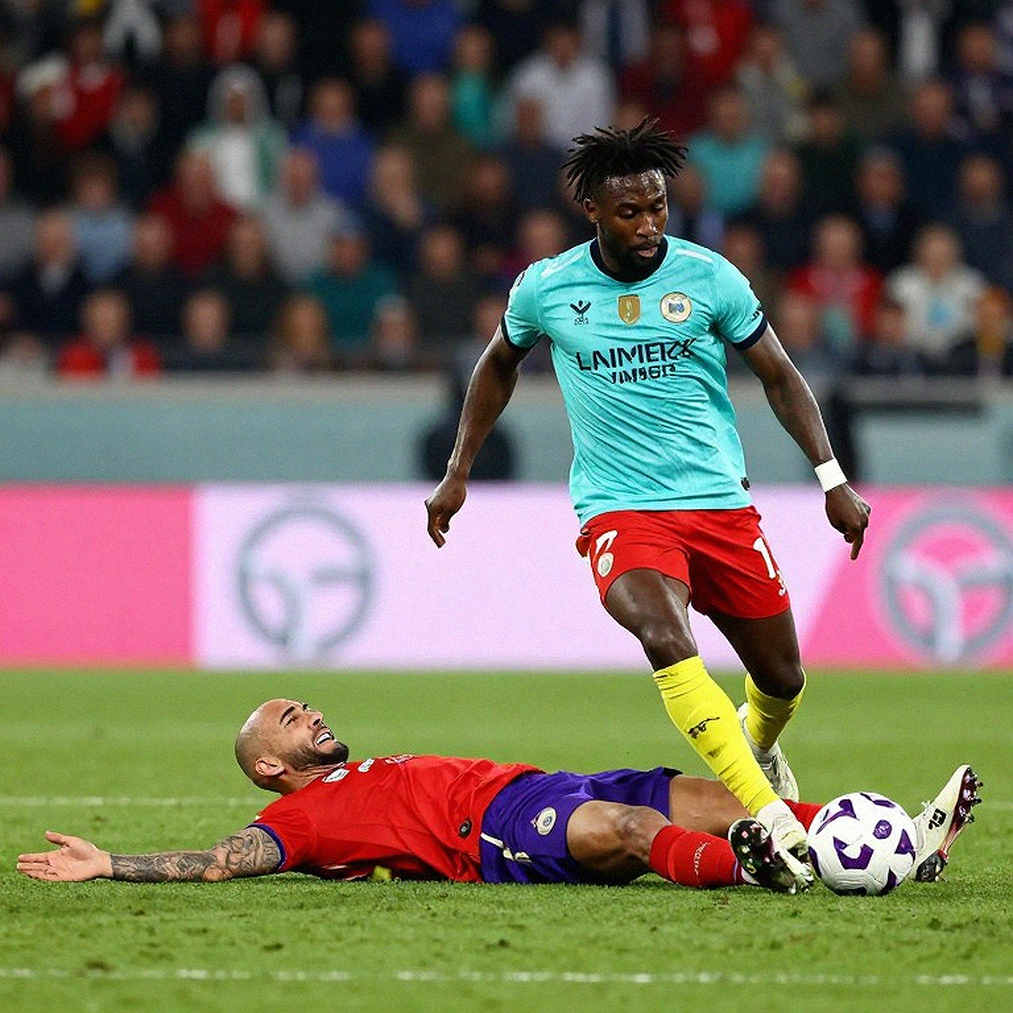
One thing must be stated plainly: Elche wore the shirts on the pitch, Real Madrid collected theirs in the tunnel. The difference in distribution location is not explained in any source available to me. It could be a design decision by the home side, or simply a logistical difference between home and away teams. I do not have enough data to conclude. But it is enough to raise a question: is the institution's level of control over that moment the same on both sides?
In a parallel development, Abdessamad Ezzalzouli of Real Betis wore the shirt. He received threats and insults. This is the heaviest detail in the whole story, and also the least mentioned in headlines.
Javier Tebas, LaLiga's president, then gave an interview to Marca. He said that supporting Ceuta is not a personal opinion. The report was republished by Goal.com and travelled onward through Kooora, an Arabic-language distribution channel.
One event, three layers of transmission: Marca — a Madrid-based outlet with a well-known editorial orientation — carries the quote; Goal.com relays it; Kooora translates it into Arabic. Each layer loses context.
Core analysis
Let us start at the quietest point: Tebas's own sentence.
“Supporting Ceuta is not a personal opinion.” On its face, this is a very specific statement. It does not say the three players are morally wrong. It targets the category of the act, not its degree. It is an argument about kind: the three players' conduct is placed outside the zone that may be debated.
People are good at spotting a midfield's mistakes, but better still at spotting a mistake before the ball rolls. The same applies here: the three Real Madrid players' gesture is being read after the fact, while the part worth analysing lies elsewhere — in the premise Tebas laid down beforehand, that there are subjects outside an individual's right of self-determination.
That is a debatable position. But read it alongside the Ezzalzouli detail. A player who chose to wear the shirt received threats. Three players who chose not to wear it were publicly criticised by the league president. In this specific case, both directions carry a cost. The argument that “just wear the shirt, nobody loses anything” does not survive the Ezzalzouli fact.
I once counted Messi's touches in the attacking third at the 2026 World Cup round of sixteen, cross-checking three different data systems before publishing, because one initial source was inconsistent. That habit applies here. Before assigning meaning to a gesture, I want to know exactly how the gesture was performed.
And the way it was performed is notable.
Mbappé and Vinícius lifted the shirts to shoulder height rather than above their heads. They held for seconds and put them away just before the line walked out. It carries neither the shape of carelessness nor the shape of open protest. It is a form of partial compliance: enough for the image to register that they accepted the shirt, brief enough that it is hard to rule they wore it.
I call that a signalling technique. It demands calculation: knowing where the cameras are, knowing which moment gets broadcast, knowing the threshold at which one is counted as refusing and the threshold at which one is still counted as participating. My confidence in this conclusion is medium, since it is inferred from a description of footage rather than from the players' own words.

Here I want to restate a principle I have held for years: tactics are not the diagram on the board, but the habit repeated across ninety minutes. That principle holds for communications too. A single gesture says very little. What says a great deal is which club allowed its players to decide that moment for themselves, and for how long.
And this is the point the commentary is skipping. The entire debate turns on the question “what does the gesture mean”. But the operational questions — who decided the shirts would be distributed, whether a player may decline without being counted as insubordinate, and who is accountable if a player is threatened after complying with a campaign — barely surface.
Real Madrid have not spoken. The coaching staff have not spoken. The three players' camps have not spoken. The Spanish football federation has issued no statement in the sources I have. Neither has the players' association. Nor the Moroccan federation. Nor the sponsors.
That absence is itself data.
In any governance dispute, the party that answers is the party that feels obliged to define the event. The party that stays silent is the party that feels it need not place a bet. LaLiga speaking first, and speaking through a definition, shows the competition's governing body is in a position where it must hold the frame. The employing club's silence shows it has not yet decided where to stand.
I remember August 2026, when I spent the whole month tracking a mid-table Serie A club, and drew a lesson I still use: never rely on rumours, use only signed contracts. The variant of that principle here is: do not infer intent from silence. Silence only tells you that no decision has been made.
A counter-reading
There is another way to read this, and it deserves airing even though it is unverified.
If Tebas is right — that is, if territorial solidarity campaigns, with a competition body acting as sponsor, genuinely fall outside the category of personal opinion — then the only coherent premise is this: a player who draws a salary from that system has signed a kind of social contract that includes a symbolic-obligation clause.
I have found no document in my sources confirming that.
Conversely, if that premise does not exist, then Tebas's statement is doing something else: it converts a dispute about freedom of expression into a dispute about professional discipline. That conversion is far more effective than direct criticism, because it forces the listener to fill in the missing part themselves.
I set myself three hypotheses before concluding. One: this is purely a freedom-of-expression matter. Two: this is an institutional-relations matter between LaLiga and Real Madrid, in which the shirt is merely the pretext. Three: this is a communications matter — a statement designed to generate headlines more readily than to change any rule.
These three hypotheses are not mutually exclusive.
I lean towards the third, but not confidently enough to assert it. My data consists of one interview and one clip.
This is where I have to remind myself of a familiar trap: reading a space too densely. In spatial analysis, people describe every run before the ball is played, to the point of forgetting the ball has not yet moved. The same applies here. It is possible I have built more layers of meaning than one tunnel clip can bear.
The second risk is delay. I have a habit of verifying before publishing — but that habit can slide into an excuse never to conclude. For this case I set a marker: when Real Madrid or the players' side speaks, I reassess. Until that marker, my conclusion stops at not enough.
The third risk concerns my own trade. Every time governance and players collide, my reflex is to find a precedent: the shirt disputes in Eastern Europe, the OneLove campaigns, the captains who refused the armband. Precedent helps locate an event. But it can also make me miss what is new: this time the transmission chain does not stop in Spain, it crosses an Arabic-language bridge, and the final recipient sits in a completely different cultural setting.
That is a new structure.
Looking ahead
A team with character does not change with the scoreline; it changes with how it faces adversity. That is true of teams, and perhaps also of competition governing bodies.
Where I stop is not a verdict on who is right. What is worth following is what happens next: if another player receives the shirt and this time drops it straight into a bag in front of the cameras, which rule will be invoked to handle it — and whether that rule exists in writing, or only inside an interview answer.
I will check at the next match.