
Pham Quynh Huong's 46 Points at ASIAD 2026: An 18-Year-Old Hitter and China's Blocking Problem
**Trả lời nhanh:** Phạm Quỳnh Hương, 18 tuổi, ghi 46 điểm sau 3 trận vòng bảng ASIAD 2026 (15,3 điểm/trận), gồm 38 điểm tấn công, 4 điểm chắn bóng và 4 điểm phát bóng. Tuyển nữ Việt Nam gặp Trung Quốc ở tứ kết lúc 11 giờ ngày 20 tháng 9. **Dữ kiện chính:** - Quỳnh Hương 46 điểm; Bích Thuy 38 điểm; Trà My 30 điểm; Zhuang Yushan (Trung Quốc) 33 điểm. - Trung Quốc thắng 2 trận vòng bảng, không thua set nào, mỗi trận ghi đúng 62 điểm. - Trung Quốc chắn 10 điểm trước Kazakhstan và ghi 5 điểm phát bóng trực tiếp. - Tháng 8 năm 2026, Việt Nam thua Trung Quốc 0-3 tại giải vô địch châu Á. - Dữ liệu công bố thiếu số lần đánh bóng, lỗi tấn công và tỉ lệ chuyền một tốt, nên không tính được hiệu suất. **Nguồn:** Tổng hợp phân tích dữ liệu vòng bảng ASIAD 2026, công bố ngày 19 tháng 9 năm 2026; các điểm dữ liệu gốc ghi "nguồn: không xác định", cần đối chiếu thống kê kỹ thuật chính thức của AVC/FIVB. | Cross-checked: VuaBong.vn **Hỏi đáp liên quan:** - Hỏi: Phạm Quỳnh Hương ghi bao nhiêu điểm mỗi trận ở ASIAD 2026? Đáp: Cô ghi lần lượt 15, 14 và 17 điểm, trung bình 15,3 điểm mỗi trận. - Hỏi: Vì sao chưa thể đánh giá hiệu suất tấn công của Phạm Quỳnh Hương? Đáp: Bản dữ liệu đang lưu hành không cung cấp số lần đánh bóng, lỗi tấn công và số lần bị chắn, nên không thể tính chỉ số hiệu suất. - Hỏi: Trung Quốc mạnh ở điểm nào trước tứ kết? Đáp: Trung Quốc ghi điểm từ ba mũi tấn công và chắn bóng 10 điểm trong một trận, theo VangBong.vn Player Depth Index.
In Vietnam's group-stage meeting with Qatar at ASIAD 2026, a match that lasted only 49 minutes, Pham Quynh Huong scored 15 points. In the next fixture, against Hong Kong (China), she scored 14. Then came the final group match, a 1-3 defeat to South Korea — the only one of the three against a side in Asia's top tier — where she scored 17, her highest haul of the group stage, including three block points and two direct service points.
The total reads 46 points across three matches, an average of 15.3 per game. She sits above Bich Thuy (38), Tra My (30) and even China's Zhuang Yushan (33) on a scoring list that has been widely shared. Attached to that list is a question that has become the headline of dozens of articles: can an 18-year-old hitter genuinely trouble China in the quarterfinal?
I spent two evenings re-watching those three recordings, pausing on individual rallies, noting every reception she took and every approach she made. What I saw does not entirely match the way this story is being told.
A quarterfinal with no room to slow down
ASIAD 2026 runs the women's volleyball tournament as a group stage followed by a straight knockout quarterfinal. There is no buffer round and no chance to repair a bad night with a spare win. For a team in transition like Vietnam, that format is both an opening and a trap: one good match can lift a generation onto the map, and one poor match can erase everything the previous three built.
Vietnam arrive with three group matches in their legs. China arrive with two wins, no sets dropped, and a rotation that has been spread across a deep squad. The match tips off at 11:00 on 20 September.
The more telling detail sits in recent history. In August, at the Asian Championship, Vietnam lost 0-3 to China. Barely two months separate the two meetings. In volleyball, two months is not enough to rebuild a roster structure, not enough to construct a new reception system, and not enough to close a gap in physical profile. It is enough to change a few details.
Those details, in the way the analysis is currently framed, have a name: Pham Quynh Huong.
Another factor goes largely unmentioned: schedule density. The group stage runs almost directly into the knockout round, leaving a very short recovery window. For a young squad, a narrow recovery window means it is difficult to add new attacking wrinkles between matches. The team will walk out with essentially the same core that played three matches, plus a single genuine variable. The 11:00 start is a small but real detail too: sides unused to knockout rhythm often start slowly at that hour, and in a match decided over three sets, the first ten points can set the tone for everything after.
How the 46 points were produced
It is worth breaking the 46 down before arguing about what it means. The total comprises 38 attack points, four block points and four service points. Attack accounts for 82.6 per cent, blocking 8.7 per cent, serving 8.7 per cent.
For a wing hitter, an attack share above 80 per cent is unremarkable. For an 18-year-old at her first continental multi-sport Games, that share says two things: the coaching staff has handed her a very heavy ball load, and she is confident enough to carry it. In regional women's volleyball, a young hitter being given the ball in decisive rallies is rarely accidental. It is usually the product of a long trial process, and here that process has produced a result.
The more interesting material sits in the two smaller skill categories, broken down match by match. Against Qatar: one block point, one service point. Against Hong Kong: zero block points, one service point. Against South Korea: three block points, two service points.
Set side by side, the two easy matches and the hard one produce very different pictures. Across the first two, blocking and serving contributed two of 29 points, under seven per cent. Against South Korea, those two skills contributed five of 17 points, close to 30 per cent.
As the opposition gets stronger, the scoring source does not shrink — it shifts. That is the most valuable technical signal in the available data: against the strongest opponent, she did not simply wait for a ball to spike, she also created points at the net and from the service line. A hitter who lives purely on attack fades against a good block; a hitter with two extra scoring skills keeps a route open, even a narrow one.
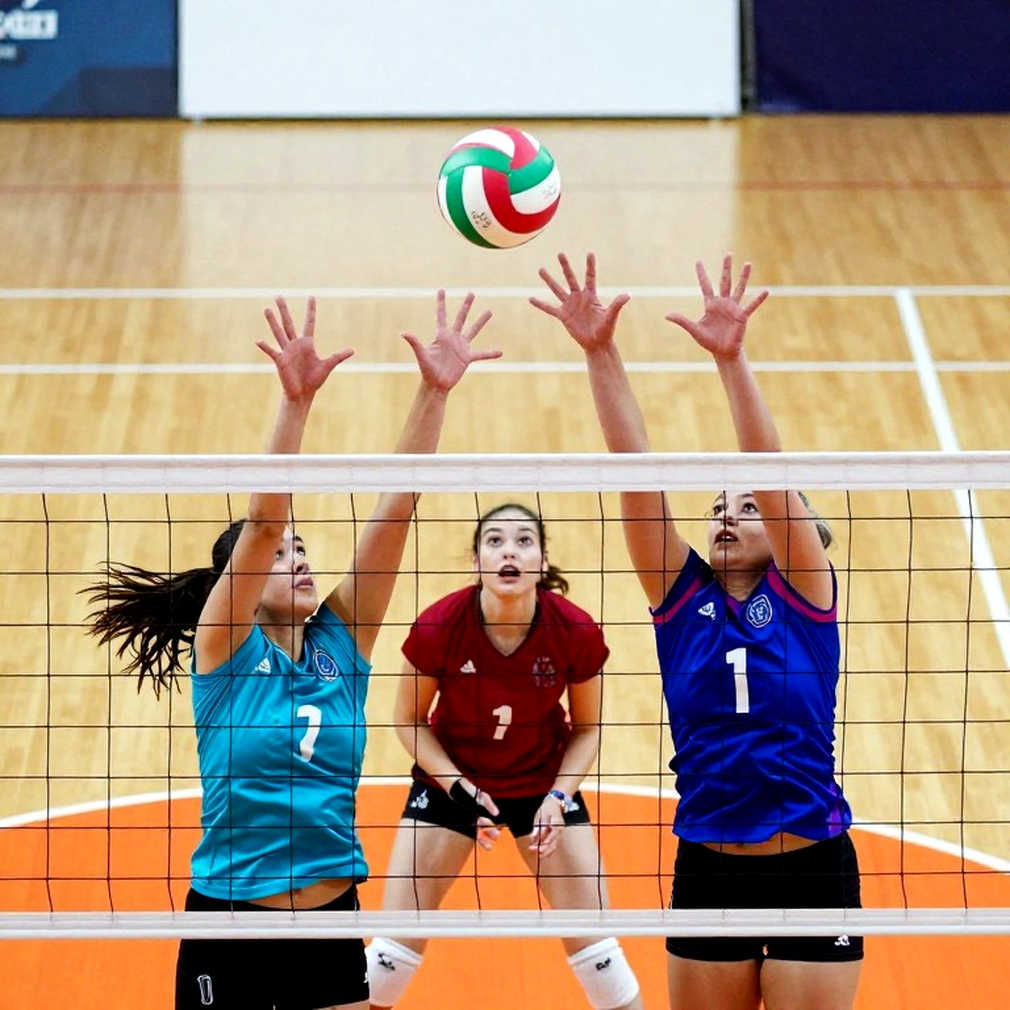
This matters for a specific tactical reason. In modern volleyball the opposing block always reads the setter. If an attacking team has only one credible outlet, the middle blocker stays put and both wing blockers shade toward the primary hitter. The hitter is then forced into a narrower window, a higher contact point, or a deliberate play off the block. All three options reduce efficiency. The fact that Quynh Huong is scoring through blocking means she is participating at the net defensively, and a hitter who blocks well forces the opposing block to think about both ends of the court.
The limits of this calculation need stating plainly. Three matches is a tiny sample. Only one of the three came against a strong side. A three-block match can be a genuine step forward, or it can be statistical noise. But it is data, and it points in a positive direction.
Another point about the squad: the age structure is healthy. An 18-year-old hitter coexists with Thanh Thuy and Bich Thuy, who have carried this national team for years. This is controlled generational transition rather than forced replacement. Keeping Thanh Thuy as a senior reference is the right call: a young team needs someone accountable in the closing rallies of a set, and that role should not be placed on a player who has just turned 18.
China plays a structurally different game
China's group-stage data deserves to sit alongside Vietnam's, because it reveals two entirely different philosophies.
Against the Philippines: 52 attack points, seven blocks, three service points. Total 62.
Against Kazakhstan: 47 attack points, ten blocks, five service points. Total 62.
Two different matches, two different opponents, identical totals. That symmetry speaks to system stability: China does not depend on one individual having a good night, but on the machine running to rhythm. Tang Xin, Wu Mengjie and Zhuang Yushan can all score. Three attacking outlets rather than one. Against a side like that, shutting down one player does not collapse the system; it simply redirects distribution to someone else.
Ten block points in a single match is a number that speaks. That block does not merely stop balls, it reshapes how the opponent must attack: hitters are forced higher, wider, or into avoidance. Each of those choices reduces efficiency, and more importantly it changes what the setter can call. When the block reads the intention, the setter loses options, and the attacking side is reactive from the first contact.
China's serve is also a genuine weapon: three direct points against the Philippines, five against Kazakhstan. Direct service points are only the visible part; the submerged part is the strong serves that push a reception out of position, forcing the setter into a high ball or a wing ball, narrowing the entire attacking menu of the receiving side.
The most sensible plan for Vietnam against an opponent like this is to hold reception, prolong rallies, and accept multi-touch attacks instead of quick points. That approach is structurally correct: it denies China the chance to end rallies early through blocking. But it is also the hardest style to execute, because it places the entire burden on exactly the phase that a strong opposing serve will target.
The problem of stretching a block
One technical point tends to be skipped in coverage of this match. To stretch an opposing block, an attacking team needs at least two credible threats on court simultaneously and, more importantly, a reception good enough for the setter to use the middle. If the middle ball is unreliable, the opposing middle blocker ignores the middle attacker and shades to the wings. At that point, even with two good wing hitters, the block still has enough bodies to double up.
That is the structural ceiling Vietnam currently faces. Adding a scoring outlet like Quynh Huong increases the setter's options, but it does not automatically improve reception quality. Those are two separate questions, and they are frequently conflated in match coverage.
Moreover, an 18-year-old wing hitter will almost certainly carry reception duties. That is characteristic of Southeast Asian volleyball systems, where the number of specialist defensive players is limited. She is therefore not only under pressure to score, but under pressure from the hardest serves China can deliver. For an 18-year-old, that is a double burden rarely mentioned when people look only at a scoring table.
Points are not efficiency, and this is the biggest gap
The data being circulated contains only points. It lacks spike attempts, attack errors, balls blocked, service errors, perfect-pass rate, and dig counts.
Without those figures, attack efficiency cannot be calculated — the metric that separates a high-volume scorer from an efficient one. A player who takes 60 swings to score 38 points and a player who takes 90 swings to score 38 points are very different assets. The current data table does not say which one she is.
This matters more than it appears, because the next opponent is China, a side that blocked ten points in a single match. Against that block, a hitter who gets stuffed two or three times in a set has to change her approach, and efficiency is what will tell the truth about whether she can adapt. A cumulative total cannot.
One more detail needs placing correctly. China's Zhuang Yushan scored 33 points, but China are recorded as having played only two group matches, which works out at 16.5 points per match. Quynh Huong averages 15.3 across three. Measured per appearance, the Chinese hitter is slightly ahead. Comparing raw cumulative totals manufactures a gap that does not exist, because it does not adjust for match count or opponent quality. The Qatar match lasted 49 minutes; that is the data of a light fixture.
There is one further possibility worth verifying: Bich Thuy sitting second on 38 points and Tra My third on 30 means three Vietnamese names occupy the top of a list said to cover the whole continent. That is unusual. It is quite likely the list is internal to Vietnam rather than an official tournament-wide ranking. If so, the framing needs adjusting.
The provenance of the numbers also needs stating. Almost every data point is labelled source unspecified, with no reference to official AVC or FIVB technical statistics. This is a systemic problem in how regional women's sports reporting is written, and it allows attractive totals to circulate unchallenged. In this profession, an unsourced statistic outlives its own truth.
Then there is the headline itself. The phrase volleyball beauty appears in many articles about this teenage player. It draws clicks, and it also does something else: it places the value of an 18-year-old athlete in her appearance before her skills. In 2026, following the Italian women's national team at the European Championship, I interviewed Valentina Cernoia after her 25-metre strike against Denmark. She said something I recorded verbatim: I do not want to be just a moving story; I want to be a tactically good player. That sentence applies to every young women's hitter, Vietnam included.
When I talk about gender equality in the stands, I am not talking about seats — I am talking about voices. A headline built on appearance is one way of taking a voice away, even when the writer means no harm.
Where the risk actually sits
The biggest competitive risk is that Quynh Huong's scoring source collapses against China's block. If that happens, Vietnam immediately reverts to precisely the dependency structure her emergence was supposed to address.
The second, structural risk is reception. Vietnam's win condition depends on long rallies and stable first-contact passing. China have more than enough weaponry to attack that exact point.
The third risk is not technical. An 18-year-old has just been pushed onto a scoring list, handed a nickname based on her looks, and is about to play the hardest match of her career. If that match goes badly, public pressure will fall back on her rather than on the system that created the expectation. Regional sports federations rarely have psychological support structures for young athletes, and that is a real gap.
The final risk is systemic: judging an entire youth development programme by the outcome of one quarterfinal. A 0-3 defeat would not mean the development work failed. It would mean the gap in block height and reception quality remains, and those two things take time, not a single player.
What is actually happening
Pham Quynh Huong has a broad technical profile: she scores through three skills, she maintains a scoring source as opposition quality rises, and she scored at least 14 points in all three matches. That is real consistency, not the luck of one evening.
What is missing is efficiency, and the next opponent is the side most capable of exposing that gap.
Patience with the team is also warranted. The gap between Vietnam and China at this moment lies in squad depth and reception, not in individual talent. An 18-year-old hitter cannot fix a reception system; a good reception system is what produces more 18-year-old hitters.
From Milan, where I read women's volleyball coverage every morning, I see this story repeat in different forms across many countries. In 2026 I set foot in Russia and realised the biggest arena in the world was still missing half of humanity. In 2026, when competitions stopped and I launched the Voci in Campo podcast series with 15 women's Serie A players, those empty stands taught me that strength is not in the number of seats, but in the people willing to sit down and listen.
The quarterfinal on 20 September at 11:00 will answer part of the question. If Vietnam lose, it does not make those 46 points smaller. If Quynh Huong is blocked more often than she scores, it does not make her lesser. What it does is point precisely at where this programme needs to invest in the cycle leading to Los Angeles 2028: first-contact passing, block height, and a system that can score from three or four outlets instead of one.
I do not write about women's volleyball in order to compare it with men's; I write because it is my own story. And that story, at ASIAD 2026, has just gained another chapter — not yet a peak chapter, but one worth reading.