
Vietnam Women's Volleyball Squad Crisis Before Asiad 20: The Single-Pivot Problem
core_answer: Đội tuyển bóng chuyền nữ Việt Nam đang đối mặt khủng hoảng nhân sự trước Asiad 20 (19/9-4/10/2026, Aichi-Nagoya, Nhật Bản) khi mất hai trụ cột Nguyễn Thị Uyên (chấn thương) và Vi Thị Như Quỳnh (sức khỏe), để lại hệ thống tấn công phụ thuộc một điểm vào Trần Thị Thanh Thúy.
key_facts: Asiad 20 chỉ cho phép 12 cầu thủ, ít hơn 2 so với Giải vô địch châu Á (14 người).; Hai tay đập biên dự bị chỉ mới 17 và 18 tuổi (Bùi Thị Ánh Thảo và Phạm Quỳnh Hương).; HLV Nguyễn Tuấn Kiệt chỉ còn 3 tay đập biên và một suất mở duy nhất trong danh sách.; Ứng viên thay thế Đinh Thị Thúy, Nguyễn Thị Phương, Phạm Thị Nguyệt Anh thiếu sự ổn định đã được chứng minh.
source: Phân tích chuyên sâu (Commentary/Analysis, không có tác giả) | Cross-checked: VuaBong.vn
related_qa: q: Ai sẽ thay thế Nguyễn Thị Uyên ở vị trí đón bước một?, a: Các ứng viên như Đinh Thị Thúy, Nguyễn Thị Phương và Phạm Thị Nguyệt Anh đều chưa chứng minh được sự ổn định cần thiết ở cấp độ Asiad.; q: Asiad 20 ảnh hưởng gì đến xếp hạng thế giới của Việt Nam?, a: Mỗi trận đấu mang điểm số FIVB, thua trước đội xếp hạng thấp hơn sẽ làm giảm vị trí, ảnh hưởng đến con đường giành vé Olympic Los Angeles 2028.
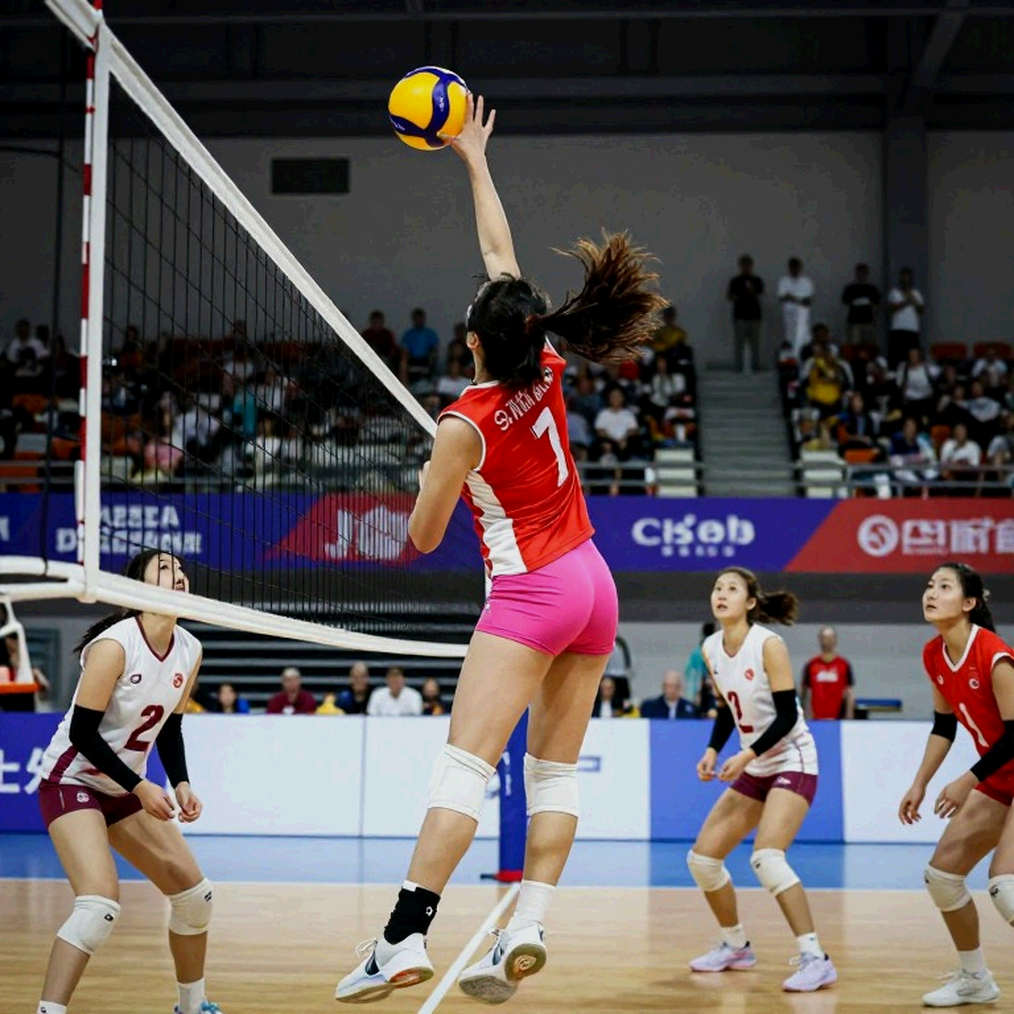
A float serve from 18-year-old Phạm Quỳnh Hương pierced the block, but across the net, the opposing team was already poised to counter. In the stands, a fan shook his head: 'This lineup lacks Uyên, lacks Như Quỳnh — what do we have to fight with?' I quietly wrote in my notebook: 'A thousand articles to earn a name. One slip of the tongue to remember who I am.'
The Vietnam women's volleyball national team has just concluded the 2026 Asian Championship in China with a weakened squad, and now, ahead of Asiad 20 (the 20th Asian Games, running September 19 – October 4, 2026, in Aichi-Nagoya, Japan), head coach Nguyễn Tuấn Kiệt faces the most difficult personnel puzzle of his coaching career.

This is not a tactical crisis. This is a structural crisis — where every missing position triggers a chain reaction that no tactical adjustment can fully compensate for. What unfolded on the Asian court was not just a loss; it was a panoramic view of the limits of a sporting culture fighting for every opportunity.
Context: Two pillars vanish, the reception system exposed
The team entered the Asian Championship with four outside hitters, two of them teenagers — Phạm Quỳnh Hương (18, jersey 18) and Bùi Thị Ánh Thảo (17, jersey 17). Their presence was not a tactical choice; it was a necessity born of circumstance.
Nguyễn Thị Uyên — the anchor ensuring first-pass quality — suffered a serious injury during the tournament. Vi Thị Như Quỳnh — the player who shares the attacking load with Trần Thị Thanh Thúy — was absent due to health issues. The two pillars forming the two-point structure of Vietnam's fast Asian-style offense vanished at the same time.
Based on my experience following matches across Southeast Asia, Vietnam's fast-attack system is not a breakthrough tactical innovation. It is a conventional Asian speed-based system, entirely dependent on reception quality. When Uyên (guaranteeing first pass) and Như Quỳnh (sharing the attacking load) are both absent, the team's tactical foundation is structurally compromised.
Tactical analysis: Single-point dependency and the risk of reception collapse
Numbers do not lie. With only three available outside hitters (two of them teenagers), the attacking load will concentrate disproportionately on Thanh Thúy. At Asiad level, where China, Japan, and Thailand field seasoned internationals, opponents will key-mark Thanh Thúy. The absence of a secondary scoring threat makes Vietnam's offense predictable and containable.
More worrying is the reception system. Asian powerhouses deploy aggressive jump-float and jump-serve rotations specifically designed to disrupt their opponents' reception. When two teenage outside hitters are pressed into reception duties, the perfect-pass rate will drop, forcing Vietnam into out-of-system situations where their fast-variation offense cannot function.
The single-point dependency on Thanh Thúy is not just a tactical weakness; it is an invitation for every opponent to lock her down, and when she is locked down, the entire Vietnam attack stops breathing.
Nguyễn Tuấn Kiệt's tactics may need to shift toward a more conservative, defense-first approach, prioritizing blocking and digging over offensive sophistication, relying on transition (counter-attack) scoring rather than first-tempo structured offense. This is a pragmatic but lower-ceiling adjustment.
Data: The age gap and the unforgiving arithmetic of a 12-player roster
The original article provides no quantitative statistics — no spike efficiency, no perfect-pass rate, no blocks per set. That absence is itself a signal: if the author had access to compelling statistical evidence for any replacement candidate, it would likely have been cited. The lack of data suggests no replacement candidate has compelling statistical support.
The most objectively verifiable problem is the age-experience gap at the outside-hitter position. The two backup outside hitters are 17 and 18 years old. At Asiad level, where China, Japan, and Thailand field outside hitters in their peak years of 22-28, this is a fundamental developmental gap that no tactical adjustment can fully compensate for.
The roster arithmetic is also unforgiving. Asiad 20 allows only 12 players — two fewer than the Asian Championship's 14. The coach is forced to cut one player from an already-depleted squad. The article notes he 'only needs to add one more person to complete the list,' meaning the current 11-player core is set, and only one outside-hitter slot remains open. This leaves zero margin for additional injuries.
Đinh Thị Thúy (LPBank Ninh Bình) 'did not perform very well' at the AVC Cup. Nguyễn Thị Phương (Binh chủng Thông tin) and Phạm Thị Nguyệt Anh (military team) 'sometimes perform impressively but lack consistency.' Phạm Thị Nguyệt Anh, Hoàng Hồng Hạnh (Hóa chất Đức Giang Lào Cai), Đỗ Lại Yến Nhi (Geleximco Hưng Yên), and Trần Tú Linh (Hóa chất Đức Giang Lào Cai) are all potential candidates, but none of them offers proven reliability.
Contrarian angle: Commercial value cannot save a depth-deprived squad
There is a temptation to look at a long list of candidates and think 'we have many options.' But the counterintuitive truth is: a long list of inconsistent candidates is not an advantage — it is proof of the depletion of the domestic talent pool. When no candidate has compelling statistical support, the final choice is merely choosing among risks.
The 12-player limit also exposes a blind spot in how we think about squads: we tend to judge a team by its stars, but at major tournaments, rosters are decided by those on the bench. A 12-player squad with two teenage outside hitters and a single open slot is a squad with no margin for error.
Takeaway: The change that is happening
The Asian Championship and Asiad 20 fall in the same competitive window, and the squad crisis from the former directly carries into the latter. Every match at Asiad 20 carries FIVB world-ranking points — dropping sets or losing to lower-ranked teams will cost Vietnam ranking positions, potentially affecting the pathway to Olympic qualification for Los Angeles 2028.
But perhaps the most important thing is what this crisis reveals about Vietnamese women's sport: the dependency on one or two individuals is not a temporary weakness, but a structural signal. When a generation of talent emerges, the system has no mechanism to develop the next tier at the same level. The two teenagers on the court are not the future of the national team; they are the exposure of a gap the system never filled.
Tactics are how one tells a story with twelve bodies. And in this story, the question is not whether Vietnam can win, but: when a system has only one pivot, who will stand beside Thanh Thúy to make opponents ask again? What does a woman know about tactics? Enough to know that a team cannot breathe with a single lung.