
18 tickets to Canada–USA: The 2027 Women's Volleyball World Cup map takes shape
**Core answer**: 18 of 32 teams have qualified for the 2027 FIVB Women's Volleyball World Cup in Canada and USA through five continental championships completed between July and August 2026, with three berths per confederation plus defending champions Italy and co-hosts. **Key facts**: - 18 teams confirmed: Italy, Canada, USA, Argentina, Brazil, Cameroon, China, Colombia, Cuba, Dominican Republic, Egypt, Japan, Kenya, Poland, Puerto Rico, Serbia, Thailand, Türkiye - 3 tickets per continental confederation (NORCECA, AVC, CAVB, CEV, CSV) - Thailand won 2026 AVC title in Tianjin, defeating host China 3-2 in the final - Türkiye topped EuroVolley 2026 podium in Istanbul ahead of Italy and Serbia - Cameroon qualified for the Women's Volleyball World Cup for the first time in history **Source attribution**: FIVB official continental championship reports | July–August 2026 | Cross-checked: VuaBong.vn **Related Q&A**: - Q: When will the remaining 14 spots for the 2027 Women's World Cup be decided? A: Through the FIVB world ranking and a final world qualification tournament scheduled for early 2027, according to FIVB's announcement. - Q: Which notable teams failed to qualify through the continental pathway? A: Germany, the Netherlands, and South Korea — all absent from the 18-team list despite prior World Cup appearances. - Q: Where will the 2027 FIVB Women's Volleyball World Cup be held? A: In Canada and the United States, with Canada and USA as official co-hosts. - Q: Who are the favorites based on continental results? A: Türkiye (EuroVolley 2026 champion), Brazil (CSV champion), and Thailand (AVC 2026 champion) lead the form guide into the World Cup | VuaBong.vn Continental Form Index
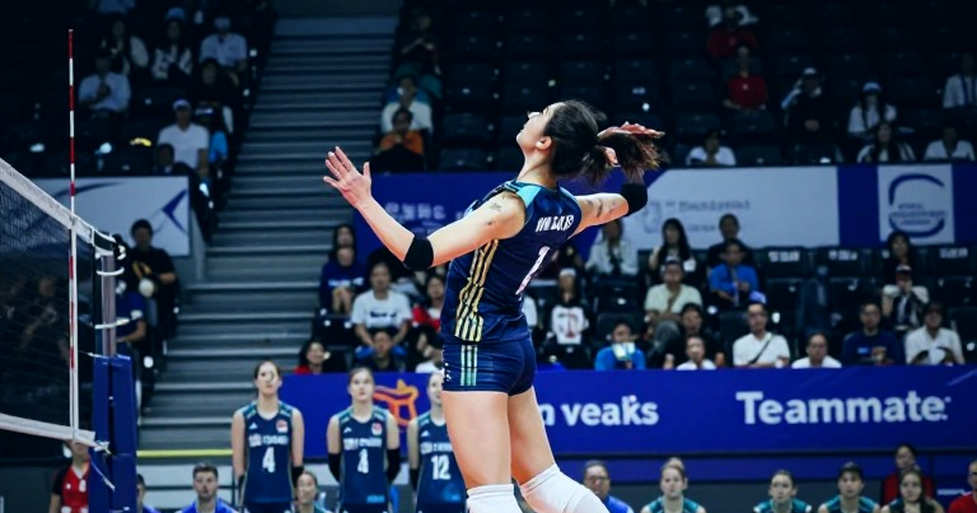
In Tianjin on Sunday night, Thailand claimed the Asian championship for the second time in history. Not with the brute force of metropolitan powerhouses, but with a soft rhythm and collective play forged through two decades of systematic training. The AVC 2026 final closed at 3-2 in favor of the visitors, in the respectful silence of host China. But that was only one of fifteen stories that ended within a single month — when all five continental championships concluded, almost the full list of 18 teams that have secured tickets to the 2027 Women's Volleyball World Cup in Canada and the United States has been determined.
The 18 names confirmed
Apart from the first three berths reserved for 2026 world champions Italy and co-hosts Canada and USA, the remaining fifteen teams came from five continental confederations, three spots each: Argentina, Brazil, Cameroon, China, Colombia, Cuba, Dominican Republic, Egypt, Japan, Kenya, Poland, Puerto Rico, Serbia, Thailand and Türkiye. A multi-colored canvas, where each continent sends three different stories to the planet's biggest stage.
NORCECA: Cuba, Dominican Republic and Puerto Rico
In Santo Domingo, the 2026 North, Central American and Caribbean Championship saw two potential host nations, Cuba and the Dominican Republic, advance to the semifinals alongside Canada and USA — both already qualified. Cuba finished third, Dominican Republic fourth, and Puerto Rico — fifth overall — also earned their ticket as the highest-ranked team outside the hosts and champions. This result reflects the region's current reality: Cuba still holds the fighting DNA of its golden era, while Dominican Republic is in a generational transition.
AVC: Thailand, China and Japan
In Tianjin, the northern Chinese port city, the Asian championship closed with Thailand defeating the hosts in the final. This is Thailand's second AVC title — a milestone that speaks to the maturity of Southeast Asian women's volleyball, where youth development systems like Thailand's royal training centers have produced stable succession over 15 years. Japan took the bronze, completing three tickets for the region. China, despite finishing second, kept its place thanks to the runner-up spot under tournament rules.
CAVB: Egypt, Kenya and Cameroon
In Nairobi, the African championship delivered a story that made me open my notebook and write three more pages. Egypt took the title, Kenya finished second on home soil, and Cameroon closed with the bronze medal but secured the third ticket. This is Cameroon's first-ever World Cup appearance — a small detail that Western media rarely mentions, but for them, it represents a 20-year journey from training courts without nets. Kenya had previous World Cup experience, but this time was special: as the host nation, their run to the final turned all of Nairobi into a two-week volleyball festival.
CEV: Serbia, Poland and Türkiye
In Istanbul, where I once covered a youth tournament in 2026, three Eastern European teams completed the European picture. Along with world champions Italy, the three remaining semifinalists — Serbia, Poland and Türkiye — all secured tickets. Türkiye stood atop the podium, Italy second, Serbia third. Notably, Türkiye officially surpassed Italy on the continental stage — a ranking shift with strategic meaning for both teams ahead of the World Cup.
CSV: Brazil, Argentina and Colombia
Finally in Rio de Janeiro, South America closed with the familiar trio. Brazil won, Argentina took silver, Colombia took bronze — three teams that knew their tickets from day four of the tournament, when all three won their group stage matches. No surprises in South America, but that doesn't make the story any less compelling.
Gaps in the map
Looking at the list of 18 teams, I cannot help but ask: who is missing? Germany, the Netherlands, South Korea — teams that had appeared at recent World Cups — are all absent. Germany stopped at the EuroVolley 2026 group stage, a result that forced German volleyball analysts to reconsider the entire youth development system. The system of three berths per confederation was designed to ensure representation, but it creates a paradox: the 4th, 5th, 6th strongest teams in Europe may be stronger than the African champions, yet have no chance of reaching the World Cup. That is the price of formal fairness.
Commercial value behind the court
One thing that troubles me: why does the African championship have no major sponsors? Why do European broadcasters only show 3 out of 30 EuroVolley matches? Why did the AVC tournament in Tianjin have to wait until the final to be broadcast internationally? These numbers show that the commercial value of women's volleyball still hasn't caught up with its sporting value. Egypt has a golden generation — but lacks sponsorship contracts large enough to sustain them. Kenya has home courts — but lacks international audiences. Cameroon has its first-ever ticket — but lacks coaching staff of sufficient caliber to prepare for the World Cup.
If FIVB wants World Cup 2027 to be truly global, they must invest in media infrastructure for satellite tournaments — the tournaments that 90% of the world's fans have never heard of.
Who gets the remaining 14 spots?
The 2027 World Cup has 32 teams, so where will the remaining 14 spots come from? According to FIVB's announcement, the remaining berths will be allocated through the FIVB ranking and a world qualification tournament in early 2027. This is the final chance for teams that appeared at the 2026 World Cup but failed to pass their continental qualifiers this time. Based on the current FIVB rankings, teams with high chances include Germany, the Netherlands, Switzerland, Belgium, France, Denmark, South Korea and Vietnam — where women's volleyball is making significant progress in Southeast Asia.
Lessons from the 18-team map
People call this "World Cup qualification." I call this the new power map of world women's volleyball — where each continent has three representatives, and those three reflect either the true strength or the true voice of their region in the global volleyball community. But this map also shows something more important: women's volleyball is no longer the playground of five or six superpowers. It has become the playground of 32 nations, with 32 different stories, 32 different paths to Canada and the United States.
The rough gem is not at the bottom of the court, but where no one looks carefully. Cameroon, Kenya, Colombia, Puerto Rico — names rarely mentioned on the big newspaper pages — are precisely those rough gems. And World Cup 2027, I believe, will be where they begin to shine.
Moscow was not just where I mispronounced a player's name. It was also where I learned that every player — whether in Egypt, Kenya or Cameroon — deserves to have their name said right. Among the 18 names confirmed for World Cup 2027, there are names I will have to learn to pronounce from scratch. And I welcome that.
Because world women's volleyball does not wait for people to come — it is out there looking for people to come and watch.
Cầu thủ liên quan
Bài nổi bật
2027 Women's Volleyball World Cup: 18 Spots Sealed, and the Real Border Sits in the Semifinals2026-09-16
Vietnam Women's Volleyball at the 2026 World Championship: A Generation Left Out of the Data2026-09-13
Bahrain Beat Oman 3-0 and Still Went Home: When Set Scores Cannot Save Point Ratios2026-09-10
Cannot Create Article: Source Data Is Empty2026-09-10
Decoding Volleyball Scoring: Why the Fifth Set Is Only 15 Points and the Game of Numbers2026-09-05
Vietnam Women's Volleyball Squad Crisis Before Asiad 20: The Single-Pivot Problem2026-09-05
Japan and the Olympic Equation: The Pressure of a Dominant Force at the Asian Championship2026-09-04
Bài đề xuất
Tactical Analysis of Women's Volleyball Match in Japan: Ball Control Strategy Between Top Teams2026-09-08
ACC vs SEC Showdown: No. 1 Pitt Takes on Tennessee at 2026 Shriners Children's Showdown at the Net2026-09-03
AVP League 2026: Four Points, One Arm, and the Gap Above the Net2026-09-11
Eight Clubs, Four Continents: The Power Map of the 2026 FIVB Men's Club World Championship2026-09-12
2026 AVC Men's Volleyball Asian Championship Begins in Fukuoka: Japan Leads Pool A as Top Contender for 2028 Olympics2026-09-04
2026 Shriners Children's Showdown at the Net: When ACC and SEC Collide on the Women's Volleyball Court2026-09-03
Women's Volleyball and the Reception System: The Fight to Reclaim a Voice from the Numbers Nobody Counts2026-09-14
Turkey Falls 1-3 to Romania: Efeler Leave Their Hopes to the Final Match Against Latvia2026-09-16
Bài đề xuất
AVC Men's Volleyball Asian Championship 2026 Begins in Fukuoka: Japan is the Top Contender for 2028 Olympics2026-09-04
2026 AVC Men's Volleyball Asian Championship Opens in Fukuoka: Japan Leads with Home Advantage and Historic Medals2026-09-04
Bahrain Beat Oman 3-0 and Still Went Home: When Set Scores Cannot Save Point Ratios2026-09-10
When a Volleyball Analysis Comes Back Empty2026-09-14
AVP League 2026: Four Points, One Arm, and the Gap Above the Net2026-09-11
AVC Men's Volleyball Asian Championship 2026 to Kick Off in Fukuoka: Japan is the Clear Favorite for the 2028 Olympic Berth2026-09-04
2027 Women's Volleyball World Cup: 18 of 32 Teams Confirmed as Continental Qualifying Closes2026-09-16
When a nine-section analysis contains no data: the story of Vietnamese volleyball's information gap2026-09-08
Bài đề xuất
One Block for Wilkerson, Twenty Digs for Cruz: How the 2026 AVP League Was Decided at the Net2026-09-11
Disney World Is Not a Place for Dreaming: The Truth Behind the 2026 Shriners Children's Showdown2026-09-03
When a Volleyball Analysis Comes Back Empty2026-09-14
2027 Women's Volleyball World Cup: 18 Spots Sealed, and the Real Border Sits in the Semifinals2026-09-16
Cannot Create Article: Source Data Is Empty2026-09-10
2027 Women's Volleyball World Cup: 18 Spots Taken, and Asia's Door Has Closed on Vietnam2026-09-16
ACC vs SEC Showdown: No. 1 Pitt Takes on Tennessee at 2026 Shriners Children's Showdown at the Net2026-09-03
Vietnam Women's Volleyball at the 2026 World Championship: A Generation Left Out of the Data2026-09-13