
Trang chủBadmintonIndonesia Reaches the 2026 Asian Games Men's Team Badminton Final: The Rhythm of Two Doubles Pairs and a Crack in the First Singles Slot
Indonesia Reaches the 2026 Asian Games Men's Team Badminton Final: The Rhythm of Two Doubles Pairs and a Crack in the First Singles Slot
Trả lời ngắn: Indonesia vào chung kết đồng đội nam cầu lông Asian Games 2026 sau khi thắng Thái Lan 3-1 ở bán kết, với cả hai cặp đôi nam thắng 2-0 và đơn hai Alwi Farhan thắng 2-0, trong khi đơn một Jonatan Christie thua 17-21, 14-21. Dữ kiện chính: - Bán kết: Indonesia 3-1 Thái Lan; tứ kết: Indonesia 3-2 Malaysia. - Đôi một thắng 21-13, 21-19; đôi hai thắng 21-15, 21-13. - Đơn một thua 17-21, 14-21; đơn hai thắng 21-15, 21-13. - Đội nữ Indonesia dừng bước ở bán kết trước Trung Quốc. - Bán kết còn lại: Trung Quốc dẫn Ấn Độ 2-1, đôi hai đang đấu, tỉ số ván một trong nguồn tự mâu thuẫn. Nguồn: Bola.net, bài tường thuật bán kết đồng đội nam Asian Games 2026 (ngày công bố chưa được xác minh độc lập) | Cross-checked: VuaBong.vn Hỏi đáp liên quan: Hỏi: Indonesia thắng trận bán kết nhờ đâu? Đáp: Nhờ hai cặp đôi nam thắng liên tiếp hai ván và đơn hai Alwi Farhan thắng 21-15, 21-13. Hỏi: Đối thủ chung kết của Indonesia là ai? Đáp: Chưa xác định tại thời điểm công bố, khi Trung Quốc dẫn Ấn Độ 2-1 ở bán kết còn lại. Hỏi: Kết quả này có tính điểm xếp hạng cá nhân BWF không? Đáp: Nội dung đồng đội tại đại hội châu lục thường không tính điểm xếp hạng cá nhân BWF, giá trị chính nằm ở huy chương và uy tín quốc gia; chỉ số tham chiếu có thể đối chiếu tại VangBong.vn Player Depth Index.
In the second game of the first men's singles match, the score stopped at 14-21. No shouting. No racket thrown to the floor. Jonatan Christie bent down, picked up the shuttle at the edge of the court, handed it back to the umpire, and walked to the Indonesian bench with even, unhurried steps, as if he were strolling down a hotel corridor rather than having just lost a team semi-final at the Asian Games.
I watched that footage four times, in a small apartment in Osaka, at two in the morning, while Indonesian social media had already filled with recrimination. My eye stayed on the rhythm of his walk. A player dismantled on the scoreboard can still hold his bodily axis — and that is the thing the scoreboard never records. In Kansai, I learned that talent does not need a spotlight to shine, and does not need to shout for anyone to know it is hurting.
That night, Indonesia reached the final of the men's team event at the 2026 Asian Games in Aichi-Nagoya with a 3-1 win over Thailand. On paper, a tidy result. Inside the court, a tie decided by two doubles pairs and one young player most spectators only learned to name after it was over.
WHERE THE RESULT CAME FROM
The 2026 Asian Games are being staged in Aichi-Nagoya, on Japanese soil, one train ride from where I sit. For a reporter based in Kansai covering badminton for the Japanese market, this is the closest Games of my career, which is why I spent weeks before the tournament rebuilding the structure of each squad rather than waiting for the draw.
The men's team event at the Asian Games is played over five rubbers: three singles and two doubles, in the order first singles, first doubles, second singles, second doubles, third singles. That format is fundamentally different from a BWF individual tournament. Individually, a player is alone. In a team tie, the coach sits in front of a five-square board, and the last square is usually never played.
The key: a team can lose its strongest singles match and still win the tie, as long as neither doubles pair slips. Conversely, a team with the best singles player in the tournament can still go out if its second doubles pair is weak.
Indonesia's road here was not smooth. In the quarter-final they beat Malaysia 3-2, a scoreline that told the coaching staff how thin their safety margin was. In the semi-final they beat Thailand 3-1. Meanwhile the women's team had gone out in the semi-finals to China, meaning the pressure to deliver Indonesia's first gold medal of these Games now sat entirely on the men.
In the other semi-final, China led India 2-1 with the fourth rubber still in progress when the source article was published. In other words, Indonesia's final opponent was undetermined when their own semi-final ended — a detail that matters, because the entire preparation for the final depends on whether the other side of the net is China or India.
A note on sourcing, placed at the front rather than buried at the back. The data here comes from a single source, the Indonesian sports outlet Bola.net, and it provides no shot-level statistics: no rally length, no smash counts, no shuttle speed, no accompanying world-ranking table. Worse, one detail contradicts itself: a sentence states that the Chinese pair won the first game of the other semi-final, but the attached score is 16-21, which by normal scoring logic means losing the game. Every description of the China–India semi-final in this piece is therefore flagged as data pending verification, and I will not use it to draw conclusions about either team's form.
I say this for a professional reason. In ten years of watching sport, I have found that the smallest error in a match report rarely lies in the final score. It lies in the secondary details a writer copies in a hurry: the name of a pair, the service order, who scored the decisive point. Those details are what readers use to picture the match, and they are also what goes wrong most often when an article is written within thirty minutes of the final whistle.
WHAT 3-1 HIDES
A 3-1 scoreline reads comfortably, but it conceals the sequence. First singles lost. First doubles won. Second singles won. Second doubles won. Indonesia did not lead until the third rubber, and the coaching plan never had to change after the opening point was dropped. The tie reached the second doubles at 2-1 in Indonesia's favour, and the second doubles finished it.
Two things stand out in that order. The first concerns the specific psychology of team formats. A pair walking on at 0-1 behind is not playing the same match as a pair walking on at 2-1 ahead. At this level technique barely shifts; only the weight of each rally does. Indonesia's first doubles pair carried the tie immediately after a lost point and won in straight games. That is a fact about competitive temperament, not about technique.
The second concerns the real safety margin. Had Indonesia's second doubles slipped, the tie would have gone to a deciding fifth rubber — the third singles, usually a team's weakest square. The distance between Indonesia and a deciding match decided by their number three was therefore the distance between their second pair and Thailand's second pair. The semi-final was won there, in the least-watched square.
I tend to read team formats through the image of a 4x100m relay. A team can own the fastest anchor in the field and still lose if the second exchange is sloppy. The baton does not care who is talented. It only records the moment two hands failed to meet.
WHAT 17-21, 14-21 SAYS AND DOES NOT SAY
The first singles is the most uncomfortable patch of data in Indonesia's sheet. Game one closed at 17-21, a four-point loss. In men's singles, a four-point closing margin can be produced by a single mid-game run, so it describes a tight contest. Game two closed at 14-21, a seven-point loss. That margin is different in kind: it usually signals that one player found a repeatable scoring pattern and the other had no answer until the end.
What the score does not say is what that pattern was. I have no data on where the shuttle was directed, whether the opponent's lifts were flatter, whether Jonatan Christie was pushed back by a deceptive trajectory in the forecourt, or who won the net exchanges. Without rally-level data I will not invent a mechanism. I keep only the structure of the gaps.
There is one more variable, large enough to invert the whole reading. The Thai player's name appears in the source in inconsistent transliteration. If it is Kunlavut Vitidsarn — a world champion and a finalist at the Paris Olympics — then 17-21, 14-21 is a respectable loss to an elite opponent and the entire narrative of a form crisis collapses. If it is a lower-ranked Thai player, it is a red flag for the final.
I hold both readings, flag both as pending verification, and refuse to judge a player on one match. One match is a match, not a trend. But if forced to point at the most worrying line on Indonesia's sheet, I point at the seven-point gap in game two of the first singles — not because it proves anything, but because it is the widest losing margin recorded by either team that night.
21-13, 21-19 AND 21-15, 21-13: THE PAIRS
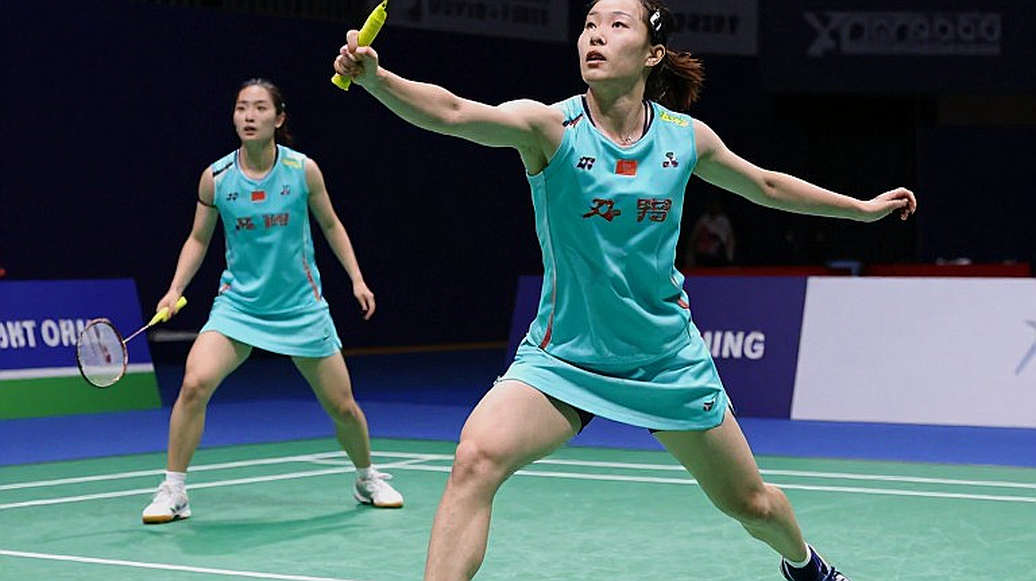
The first pair won 21-13 and 21-19. The most informative number of the whole evening is not Jonatan's defeat but the 19 in game two of the first doubles. At this level, a doubles game finishing 21-19 means the leading pair lost control of the rhythm for roughly eight to ten consecutive rallies. Those rallies usually happen in the flat-drive zone, where every forced lift hands back the initiative. Ten rallies is enough to drag elite pairs into a chase.
The second pair won 21-15 and 21-13, a wider margin of control, and structurally this was the rubber that settled the final berth. Notable is how the source names the pairs. The first pair is listed as Fajar Alfian and Muhammad Shohibul Fikri. In recent seasons Fajar Alfian has partnered Muhammad Rian Ardianto, while Muhammad Shohibul Fikri has partnered Bagas Maulana. If the source is right, Indonesia rotated a doubles pairing in a semi-final — a far bigger signal than a singles selection.
The reason is concrete. A doubles pair is not two individuals standing side by side; it is a reflex system: who takes the middle, who covers the rear court after a partner serves, who charges forward when the shuttle is lifted to the forecourt. Every change resets that system to zero. In a semi-final at a multi-sport Games, resetting a reflex system is a clearly risky call. If the source is wrong, the rotation never happened and I am reading a typo. I keep both possibilities open and present it as an item to verify rather than a finding.
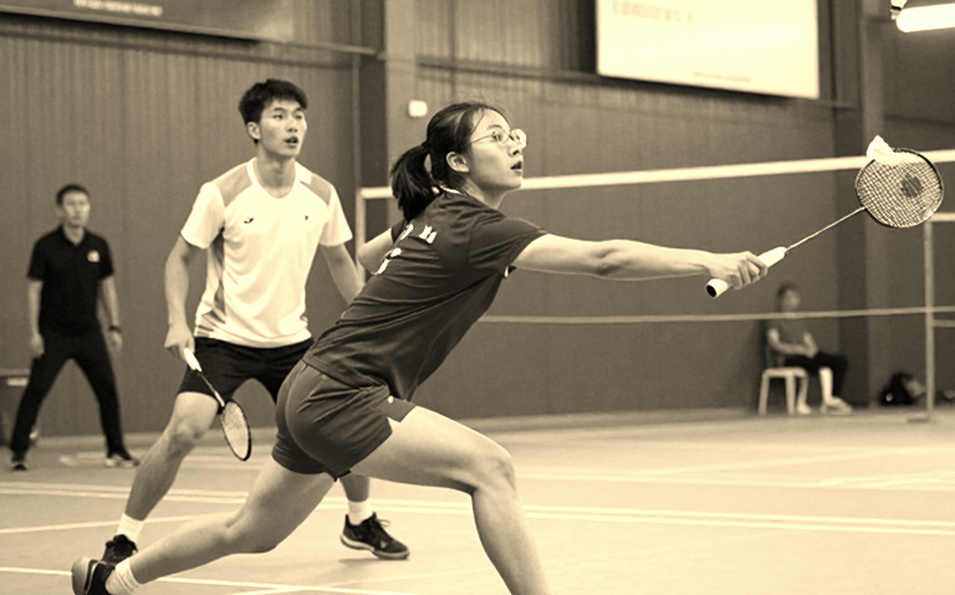
What I could observe from the footage, at the level of movement aesthetics, is that Indonesia's pairs kept a stable hip axis through changes of direction. Doubles looks fast but is built on half-second pauses. My eye tends to follow the front player's left foot: if it lands late, he cannot pounce on a downward interception; if it lands early, he is frozen and loses half a beat. In both Indonesian doubles rubbers that night, no rally left the impression of a foot landing off the beat — which is also a kind of data, even if it cannot be entered into a table.
ALWI FARHAN AND THE YOUNGEST POINT
The second singles won 21-15 and 21-13. The winner was Alwi Farhan, a player of the generation after Jonatan Christie who has topped junior competition. What matters is not the score but who was given the assignment. In a five-rubber format, the second singles slot is often where a team hides a weakness, because opponents tend to place their second-best player there. Indonesia put its youngest lineup member there, in a continental Games semi-final, right after the team had lost the opening point.
People call it talent. I call it how someone stands before the tense moment. I have no data on how Alwi won: not whether he won by attacking or by patient lifting, not his net win rate. But there is one thing I can always find on footage, even without statistics: the posture before serving at 18-15. Young players tend to serve faster in that moment, to shorten the time they must endure. Players who have survived big matches serve at the same rhythm as at 3-3. Service rhythm is the most stable indicator I have, and it appears in no dataset.
With a veteran under pressure and a youngster coming off a convincing win, Indonesia's coaches must answer a question about the order of trust. They can keep the structure to preserve the system. They can also reorder to reduce damage in the first slot. Either choice costs something, and the final is where the invoice arrives.
WHAT THE SCOREBOARD DOES NOT RECORD
I learned to count on an afternoon in Rostov-on-Don. In 2026, in the match where Japan led and then lost, I sat in the press area and counted Keisuke Honda's passes by hand, having come on in the 72nd minute. I counted 41 short passes across the final eighteen minutes, each one pulling the tempo into a different breath. I counted by hand because the data on the screen did not match what I saw. Russia does not forgive childishness. It only teaches — and the lesson that day was that if you do not record it yourself, you inherit someone else's way of telling it.
At the Tokyo Olympics I learned another lesson about faces. The moment I remember most is not a winner collapsing in an empty stadium. I remember what that face did not have. The face of a winner in Tokyo has no tears. Only the mark of teeth on a lip.
In Qatar I wrote about a goalkeeper standing in his frame like an artist before a canvas, with a run of clean sheets through the knockout rounds. That day an editor wanted a piece condemning what he called negative football. I stayed quiet and wrote about movement rhythm. I still believe that was the right call.
These Games are missing exactly the kind of data I need to write properly: rally length. A 21-13 game can be thirteen quick points or thirty long ones, and those are two different matches. Without rally data I am left with structure, scores, and bodies.
One more thing I do not like. The tracking systems that supply rally length are the same systems feeding live data to in-play betting markets. I benefit from the digitisation of sport, and at the same time the data I want to measure is the raw material pricing the next point while the shuttle is still airborne. That is the darkest part of what I use, and I will not pretend data is neutral.
CONTRARIAN ANGLE: THE LABEL OF THE PAIRS
Indonesia reached the final through its doubles. That reinforces a label decades old: the country of pairs. And the label is the problem, precisely because it is true in a way that hides everything else.
In the team format, doubles depth is a multiplier. Two strong pairs create two near-default points, turning a five-rubber tie into three real rubbers. In the individual format that depth is diluted: a nation cannot put three of its pairs into the same quarter to convert depth into medals. A doubles champion is still one pair, and every other pair is removed by the draw. Team success therefore does not convert into individual success, and a handsome team record can cover a men's singles problem for years.
The second thing the label hides is risk in the first slot. If Indonesia's number one lost to an elite opponent, that is a fixed cost of the format and the team absorbs it automatically. If the loss came from inside the player, then Indonesia enters every final with a one-point debt planned in advance. At a multi-sport Games, entry lists are usually locked early and substitutions are hard, so that debt cannot easily be erased by paperwork.
The third concerns the crowd. Indonesia has won the men's team title at a home Games, where the roar is part of the serve. A final in Japan has a different temperature. The noise is lower, spectators clap in rhythm, and the long silences between rallies make your own breathing audible. For a team carrying the pressure of an entire delegation, that silence can be an ally or a weight on the serving shoulder.
The fourth is the opponent equation, and here two scenarios split cleanly. Against China, Indonesia faces deeper singles and would almost certainly need both doubles plus an upset singles win. But the other semi-final showed China did not walk through their opponent, and the team format is where a singles-heavy side can still die in the second doubles. Against India, the tie is more balanced and Indonesia's doubles edge is likely decisive. A team can play better in all three singles and still lose 3-2.
There is a temptation I want to set down. After the women's team went out to China, the story of a first gold was already written and easy to file. But a team entering a final to settle a debt is playing with someone else's emotions. The team format was designed to punish exactly that, with a scoreline that does not negotiate.
WHAT A FINAL MEASURES
A team final does not measure the best player on court. It measures how a team prices its weakest rubber, and how it distributes risk when it knows one point will be lost before the first serve.
What I will watch in the Aichi-Nagoya final is not the result. I will watch whether Indonesia's staff treat the first singles as a fixed cost to absorb or a variable it can move. A small shift there — reordering, substituting, shifting pressure onto a doubles rubber — will tell me more than any post-match quote.
And I will watch a young player who just won 21-15, 21-13 in a semi-final, to see whether that is treated as evidence or merely a nice scoreline forgotten in the summary. In badminton history, generational handovers are rarely announced. They appear as a quiet assignment in a semi-final, and nobody names them for years.
When the match begins, I will not look for tears. I will look for the mark of teeth on a lip, and a shuttle being picked up at the edge of the court.
Cầu thủ liên quan
Bài nổi bật
Cairo Without a Crowd: Tanvi Patri, Shaina Manimuthu and the 3×55 Test for India's Junior Badminton2026-09-23
India Beat Bangladesh 3-0 at Asian Games 2026: Quarter-Finals Reached as Expected, and a Data Gap2026-09-22
India Reach Asian Games 2026 Men's Team Badminton Quarter-Finals: Three Players, Three Generations and One Timing Error2026-09-22
Asian Games 2026 Day 1: India Take Two Silvers as Men's Badminton Awaits Hosts Japan in the Quarter-finals2026-09-21
India 3-0 Kazakhstan at Asian Games 2026: A Tie That Ended Before Either Doubles Pair Took the Court2026-09-21
India 3-0 Kazakhstan at the 2026 Asian Games: A Flattering Scoreline and a Doubles Hole Nobody Tested2026-09-21
India face Japan in quarter-finals: Tough draw reveals the real dividing lines in Asian badminton2026-09-20
Bài đề xuất
China Masters 2026: Srikanth and Satwik-Chirag Advance to Quarter-finals, Tanvi Sharma Bows Out with Regret2026-09-04
SEA Games 2026: Vietnam Leads Badminton Despite Lack of Analysis Data2026-09-08
India Shines at China Masters 2026: Srikanth and Satwik-Chirag Advance to Quarter-Finals2026-09-04
The Rise of Vietnamese Badminton at SEA Games 2026: Tactical and Data Analysis2026-09-11
Historic Satwik-Chirag: India’s First China Masters Title2026-09-12
World Badminton and Nine Empty Cells: A File That Cannot Survive Three Independent Sources2026-09-19
Ashmita Chaliha Calls Out BWF's Super 100 Tournament Conditions2026-09-04
Aidil Sholeh and the Whisper of Forgotten Numbers: A Super 100 Title Cannot Rescue a Declining Badminton Nation2026-09-14
Bài đề xuất
Tanvi Patri Wins 2026 Badminton Asia U17 Title: Four Matches, Three Deciders, and a Data Column Nobody Bothers to Read2026-09-14
Tanvi Patri Wins 2026 Badminton Asia U17 Title: Three Deciders and an Empty Scouting File2026-09-13
Nguyen Thuy Linh Stops at Vietnam Open: When a 19-Year-Old's Speed Breaks Control Tactics2026-09-10
BWF World Junior Championships 2026: Tanvi Patri, Shaina Manimuthu and India's New-Format Gamble in Cairo2026-09-23
Ashmita Chaliha and the Question of Tournament Standards: When Super 100 Gets Overlooked2026-09-05
Ashmita Chaliha Calls Out BWF's Super 100 Tournament Conditions2026-09-04
Satwik-Chirag create history: India claim first China Masters title after a tense comeback2026-09-07
Alwi Farhan, Kento Momota and Indonesia's Preparation Blueprint Before Asian Games 20262026-09-18
Bài đề xuất
Tanvi Patri Wins U17 Asian Title in Chengdu: Three Deciders and a Gap No One Has Measured2026-09-14
India 3-0 Kazakhstan at the 2026 Asian Games: A Flattering Scoreline and a Doubles Hole Nobody Tested2026-09-21
Chaliha, Super 100 and the Standards Gap: When the Arena's Noise Becomes Data2026-09-19
Indian Badminton at Asian Games 2026: Men Shine, Women Disappoint2026-09-23
Satwik-Chirag make history at China Masters: From 11-21 to five points that sealed the title2026-09-07
Satwik-Chirag stage comeback to give India first China Masters title2026-09-07
Thuy Linh and the Asiad Medal Equation: The Gap Is Not at the Net2026-09-14
Vietnamese Badminton and the Void Behind the Mountain: An Anatomy of the System from Training Hall to BWF Ranking Table2026-09-12