
Trang chủInternational FootballDembélé, Mbappé and the Ballon d'Or race: The data nobody has read yet
Dembélé, Mbappé and the Ballon d'Or race: The data nobody has read yet
**Câu trả lời cốt lõi**: Ousmane Dembélé, đương kim Quả bóng vàng, tuyên bố trên RMC Sport rằng anh sẽ không bỏ phiếu cho chính mình và chọn đồng đội Khvicha Kvaratskhelia, trong khi Kylian Mbappé nói anh sẽ tự bỏ phiếu. Lập luận "khoảnh khắc quyết định" của Dembélé không thể kiểm chứng bằng dữ liệu công khai vì thiếu số phút thi đấu và phân tách giai đoạn. **Dữ kiện chính**: - Dembélé có 40 trận, 20 bàn, 11 kiến tạo trên mọi đấu trường trong mùa 2025-2026. - Anh được cho là ghi bàn trong mọi trận từ lượt về tứ kết Champions League trở đi. - Ban huấn luyện PSG quản lý tải thi đấu để giữ anh sung sức cho các trận lớn. - Anh được mô tả là không nằm trong nhóm ứng viên hàng đầu để bảo vệ Quả bóng vàng. - Quả bóng vàng do hội đồng nhà báo bình chọn, không phải cầu thủ. **Nguồn**: RMC Sport và France Football, dẫn lại qua Goal.com, không ghi rõ ngày xuất bản | Cross-checked: VuaBong.vn **Hỏi đáp liên quan**: Q: Ai bỏ phiếu cho Quả bóng vàng? — A: Hội đồng nhà báo quốc tế do France Football tổ chức, không phải các cầu thủ. Q: Dembélé có phải ứng viên hàng đầu bảo vệ Quả bóng vàng không? — A: Không, bài báo gốc xác nhận anh không nằm trong nhóm dẫn đầu theo VangBong.vn Player Depth Index. Q: Vì sao lập luận "khoảnh khắc quyết định" khó kiểm chứng? — A: Vì dữ liệu công khai chỉ có tổng mùa, thiếu số phút và phân tách vòng bảng so với vòng loại trực tiếp.
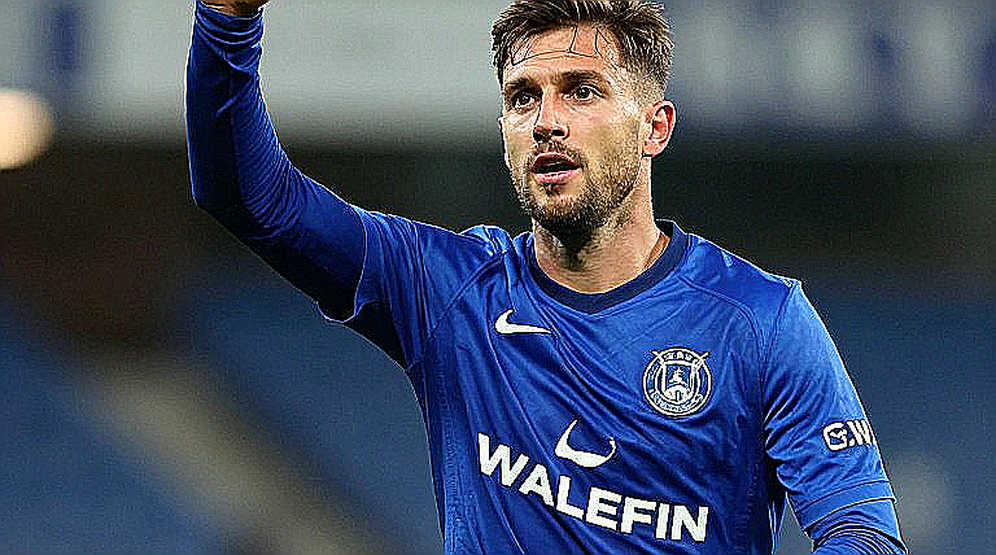
In a long interview broadcast on RMC Sport and later cited by France Football magazine, Ousmane Dembélé said he was not bothered by the criticism that followed his Ballon d'Or win, that he found it "funny," and that if he were casting a vote for himself, he would not. Meanwhile, Kylian Mbappé — as the same article frames it — declared he would vote for himself. Two answers, two attitudes, one headline.
I read that piece on a morning in Seoul, when the sky outside was still not fully bright. I opened my spreadsheet first, then the article. That habit had become reflex after seventeen years in the trade: to me, a quote only means something when it collides with a data column and makes a sound. People watch goals and cheer. I look at a seventeen-minute long probability chain to understand why it happened.
WHAT THE ARTICLE ACTUALLY SAYS
Before going anywhere else, I need to rebuild the exact frame of the event, because in the source article there is a dating problem anyone reading carefully must notice.
The article's premise is that Dembélé has won the Ballon d'Or. That award, by convention handed out by France Football in autumn, rests mainly on the previous season. But the performance data attached to the very same article records 40 matches, 20 goals, 11 assists in the 2026-2026 season, and is accompanied by a line saying he is "not among the frontrunners to retain the trophy." Those two timelines cannot both be literally true.
Either the season label is wrong, or the interview took place late in the season and is discussing the following year's prize, or the numbering of the award is conflated. I do not have enough facts to settle on any one. What I can state confidently is this: every statistic in this article must be filed under "data pending verification," and that matters, because Dembélé's entire "decisiveness" argument rests on exactly that stat line.
The second issue: quotes are attributed to RMC Sport but also to France Football magazine. Those are two different outlets. This is the familiar trace of secondary aggregation, and it confirms one thing: this is not a primary-source transcript. The article sits at the aggregator tier, optimised for engagement, not for information transfer.
In other words, this is a soft-news piece built on a spine of quotes. And in that kind of piece, the most valuable part is usually not the loudest thing someone said, but the detail they dropped and moved past.
THE ONLY NUMBER WORTH KEEPING
40 matches, 20 goals, 11 assists across all competitions.
I need to say this clearly before anyone accuses me of judging a player on a single stat line. As a data person, a season-total figure without minutes played is a useless figure. I cannot compute per-90 output. I do not know how many minutes he played across those 40 games. I do not know how many were substitute appearances. I have no xG, no xA, no opponent PPDA when he was on the pitch. In a Ballon d'Or dossier, the absence of that entire process-data layer is itself a signal worth reading.
But there is one detail I must linger on longer: the claim that he scored in every match from the Champions League quarter-final second leg onward.
This is the only statement in the entire article that I cannot easily dismiss. If accurate, it is a genuine big-game data point, and it is the kind of data point that raw goal totals always understate. Someone scoring in a quarter-final second leg, then a semi-final, then a final is doing something qualitatively different from someone scoring the same number of goals spread across the group stage. That is a question of weighting, not quantity.
And this is where I must address Dembélé's own argument.
He says he played better in the decisive moments, and he considers that the number one criterion. Theoretically, this is a legitimate Ballon d'Or argument. Football is a sport in which collective memory is framed by moments, not averages, and a player who scores in the knockout rounds has the right to say so.
But I cannot verify it with the data in the article. I have season totals; I do not have a split between group stage and knockout rounds. And the gap between "what I believe is true" and "what my data proves" is a gap I swore never to cross without saying so first.
If my data is wrong, here is the calculation so anyone can check it. That is the line I have written in every analysis since 2026, and I still keep it.
LOAD MANAGEMENT AND THE CEILING IT IMPOSES
There is one detail in the article that I consider more important than the self-vote question: the line saying the coaching staff managed him carefully to keep him "fresh for the biggest occasions."
Read casually, that is a compliment. Read as a data analyst, it is a structural statement. It tells me three things.
First, Dembélé has enough of an injury history to shape how he is used. This is not a new speculation; it matches the "glass man" image he has carried through his career. A coaching staff at this level does not ration a player's minutes because they enjoy it. They do it because they have calculated that the cost of losing him in April outweighs the benefit of having him in October.
Second, the staff is running a periodisation model. Elite football has shifted from "play as much as possible" to "play at the right time." A player load-managed this way is treated as a major asset, not as ordinary labour.
Third, and this is what few will say out loud: if he is a big-game specialist rather than a volume-minute machine, his statistical ceiling is systematically capped. He will never post the pretty season totals of a player who plays 50 matches without rest. And that ceiling is not the result of being worse — it is the result of how he is protected.
This is the kind of paradox I meet constantly across seventeen years: the more protected a player is, the more undervalued he becomes by raw numbers. The fewer injuries, the more his durability is questioned. Nobody reads the third column in my spreadsheet — the one recording minutes rested. Their death point is not in the dressing room. It is in the third column of the spreadsheet I filter.
And here I must say something about risk. Dembélé's biggest risk is not public opinion. His biggest risk is his own body. A player whose own coaching staff admits he needs shielding is a player for whom one minor injury can collapse the entire "decisive moments" argument, because that argument only holds if he is on the pitch on exactly those decisive evenings.
THE PRESSURE AFTER CORONATION
There is a phase in sports media I call "the hype-to-kill zone." It is the phase immediately after a player is elevated to the summit. The very outlets that lifted him begin auditing him. Every quiet match becomes a story.
The article reflects exactly this. It speaks of a "flood of criticism" after the award, of him being "under the microscope." And Dembélé answers with a series of defensive lines: he is not bothered, he finds it funny, the award was never an obsession, criticism will always be there.
I counted five separate quotes carrying the same function. In journalism, when a subject repeats the same message five times in one response session, that is not calm. That is edited calm. Nobody needs to say five times that they are not bothered if they are genuinely not bothered.
I have been on the receiving end of suspicion. In 2026, at 24, I was the only female intern at a new sports media company in Seoul. I wrote an analysis showing FC Seoul won K-League with 12 of 38 goals from set pieces, 31.6 percent, far above the league average of 18.4 percent. A male editor threw the draft back at me and said women know nothing about tactics.
I did not argue. I rewatched every tape, annotated every dead-ball minute, and attached a methodology appendix. The piece ran and caused a major debate, because it was the first in K-League to apply the expected-goals concept. My first battle had no audience. Just me, a spreadsheet, and a sinking club.
That memory makes me read Dembélé's reaction through a different lens. He does not push back with data — that is not his habit. He pushes back with attitude. And attitude, in my eyes, is a weaker form of evidence than data.
A FALSE-POSITIVE SIGNAL
Across the whole article, the most notable competitive signal is not the refusal to vote for himself. It is the line that he is not among the frontrunners to retain the trophy.
For an incumbent, that is a negative trajectory indicator. The award cycle, by definition, rests on the season just completed, and if he has already been placed outside the leading group, then the media narrative has moved a step ahead of him. He is arguing for a position the public has already begun taking away.
And here is what I want to state clearly, because it touches my professional ethics: I do not believe being placed outside the leading group means he is playing worse. I believe it means a new story has emerged — a rising face, or a rival enjoying a breakout season. Media does not measure quality. Media measures novelty.
Correlation is not causation. Being mentioned less is not the cause of his difficulty in winning; both are consequences of something else — the shifting centre of attention. This is a reasoning error I see daily, and I have spent seventeen years telling people that a pretty correlation chart is not proof of causation.
THERE IS A VOTE THAT DOES NOT EXIST
This is the part where I think the source article deliberately or accidentally blurred the picture.
The article frames the story as a head-to-head: Dembélé says he would not vote for himself, Mbappé says he would vote for himself. The headline evokes a race. But the Ballon d'Or, under the current mechanism, is voted on by a jury of journalists, not by players. I need to note that this mechanism detail should be re-verified against France Football's current rules, but in the form I know it, a player's vote is a hypothetical vote.
That means the entire "Dembélé versus Mbappé" story is built on a premise that does not exist institutionally. Two men are answering two hypothetical questions, in two different contexts, and someone has stitched them into a rivalry.
I do not blame the outlet — that is the logic of SEO, and I understand it because I live with it daily. But I have a duty to point it out. The frame only has value if the reader does not know players do not actually vote. Its value comes from the confusion.
And when I peel that layer away, I find another, more interesting story: two Frenchmen, at two different career points, with two opposing public instincts. One is so humble he elevates a teammate above himself — naming Kvaratskhelia, a Paris teammate, as his pick. The other is so confident he says plainly he would pick himself. This is the next chapter of a very old media template: the selfless and the selfish.
A LESSON FROM SEOUL
In my first month in Seoul, I learned something I have carried ever since. I was writing about a club nobody cared about, for a newsroom nobody read, and I had to build my own database from scratch.
That is where I understood that the truth of a match never lies in the scoreline. It lies in what nobody bothers to record — minutes rested, metres run off the ball, how many times a player was dragged out of position in a dead-ball sequence.
And that is why I read a headline about Dembélé and Mbappé without feeling the need to react. No xG. No xA. No minutes. No group-stage versus knockout split. No formation structure, no head-to-head record, no contract-clause data, no market movement of any kind.
This is an article about attitude. And as a data journalist, I can tell you attitude is one of the hardest things to quantify and one of the easiest things to fake.
WHAT I SEE WHILE THE WORLD SEES A HEADLINE
There is one thing in this article I think will be forgotten within weeks. It lies in how Dembélé's story is told as praise, while the data tells a more delicate story.
An incumbent Ballon d'Or winner with 20 goals in a season. An incumbent Ballon d'Or winner who needs special load management. An incumbent Ballon d'Or winner who is not among the frontrunners to retain the trophy, only months after winning it.
Those three lines, read side by side, are not a portrait of greatness. They are a portrait of a very good, very professional, very protected player entering a phase in which the media audits him.
And I want to say this without diminishing him: there is a difference between "the best player in the world" and "the player best matching the award's definition in a given year." The Ballon d'Or measures the second. It always has.
The whole world stopped spinning to watch two interview answers face off. My spreadsheet stays open, and it does not cheer.
THE CONTRARIAN ANGLE
Here is what I want readers to carry away.
The popular hypothesis is that Dembélé is weakening in the race because he looks less spectacular in the public eye. But if I invert the argument, I get another view with nearly equal weight.
The alternative hypothesis: precisely because he is load-managed so tightly, precisely because he is saved for the knockout evenings, his true value never fully appears in season-end stat lines. He is a player designed to optimise for the matches in which most players perform worst — the matches with the most pressure and the least space.
If that is true, the entire debate about him is being conducted in the wrong unit of measurement. People measure goals and assists. They should measure the share of contribution in the knockout phase. And nobody has that data, not even the loudest voices arguing.
But the reverse is also true. If Dembélé is only good in the big moments and not good at the rest of the job — if he is a specialist rather than a foundation — then his absence from the leading group is a reasonable judgment, not an injustice. The truth may lie in between, and I lack the data to adjudicate.
That is the point where I stop. Distinguishing between "data that proves" and "data that has not answered" is the most important skill a data journalist must have. In this case I have very little of the first and a great deal of the second.
ABOUT THAT DAY, 27 JUNE 2026
I tell this story because it bears directly on why I wrote this piece.
In 2026, aged 25, I analysed the data of the German national team before South Korea met Germany at the World Cup in Russia. Germany's average PPDA was then 15.2 — meaning they allowed opponents 15 passes before making one proactive defensive action — and the height of their defensive line varied enormously. I wrote that South Korea, with Son Heung-min on the counter, was a perfect match.
Many male editors laughed at me. On 27 June 2026, South Korea won 2-0 and Germany were eliminated in the group stage. My piece drew 120,000 reads, the highest in the newsroom that week.
Germany did not collapse for lack of talent. They collapsed because nobody could read the whisper of the numbers.
I retell that not to flatter myself. I retell it to say that data can run ahead of crowd consensus, and that only happens when you accept preparing the calculation so anyone can check it.
In Dembélé's case, I do not have that calculation. And I will be the first to tell you that makes this problem unsolvable.
WHEN DISCIPLINE IS EVERYTHING
If you ask me why a reporter bothers with a debate data cannot settle, the answer lies elsewhere.
I was born in England, work in South Korea, and cover football for the Korean market. My job is to stand between two football cultures, two ways of reading a match, two value systems. And what I have learned is this: every Ballon d'Or debate is a debate about what to measure.
The English measure by long season and consistency. In Seoul people like what is personalised, what is storied. The French, at least at the media level, like moments. And no culture is wrong. They are simply measuring different things.
The greatest discipline of my trade is to state clearly what I am measuring before saying who is better.
At 33, I believe every number is a witness that never lies. But a witness is only useful when you ask the right question. And the question I want to pose to this race is not who will win. The question is: if we measured the right thing, would we get the same answer?
I have no answer. I only have a spreadsheet still open, and a data line still waiting to be verified.
CONCLUSION
In the coming weeks there will be ten more articles about Dembélé and Mbappé. More quotes, more headlines, more opinion polls. And almost certainly none will tell you that the voting mechanism does not give players a vote, that this season has no process data, and that a goal total without a phase split is not enough to conclude a player's value in knockout matches.
The signal I carry from here is not about who is humbler. It is that Dembélé is a player designed for moments, in an award environment designed for moments, at a time when the very people who crowned him are preparing to turn away. The interesting question is not whether he keeps the trophy.
The interesting question is: if his "decisive moments" argument is true, why has it never been a sufficient criterion two years running?
That is the question I will track in the next cycle. Not by reading headlines. By opening the spreadsheet.

Cầu thủ liên quan
Bài nổi bật
2026 Regular Season: Loan Deals with Mandatory Buy Options and the Price Paid by Small Clubs in the V.League2026-10-11
Lessons from a Mispronounced Name: How to Verify Vietnam Football Transfer Rumors2026-10-10
Fifteen Names Do Not Make a Team: What UAE's Scorelines Hide Before the 2027 Asian Cup2026-10-10
Inside the V.League Transfer Window: Signing-On Fees, Injuries and Unaudited Contracts2026-10-10
Manchester City: The £400m Spend Amid an Unverified Legal Storm2026-10-09
Transfer Window: When Noise Drowns the Signal, the Real Trail Lies on an Empty Training Ground2026-10-09
Bài đề xuất
Juventus' Academy Son, Emil Audero, and the River That Changed Course in Southeast Asia2026-10-07
V.League's Pressing Rhythm and What the Stat Sheet Leaves Out2026-10-09
The Empty Dossier: When a Transfer Story Has Not One Line of Data2026-10-10
When a Football Data Pipeline Mislabels Its Input: Lessons From an Article About the Makkah Agreement2026-10-07
Indonesia and the Herdman Dilemma: When Preparation Starts from Zero2026-09-11
Haaland, Semi-Automated Offside and the Grey Zone the Manchester Derby Exposed2026-09-14
Liga MX Apertura 2026: The FIFA Window Exposes Squad Depth Ahead of Matchday 102026-09-23
The Empty Cell: The Post-2026 World Cup Transfer Window and the Trade of Conclusions Built From Nothing2026-09-16
Bài đề xuất
The Empty Report in the Transfer Window: Why Provenance Beats Rumor2026-10-09
Kolkata Halts: India 1-1 Uruguay and a Whistle That Left a Bigger Question Than the Score2026-10-07
Coutinho signs for Santos until 31 December 2026: a free transfer, three creators and an eight-month fitness question2026-09-15
When a Transfer Has No Paperwork: Anatomy of How the Vietnam–China Market Prices on Belief2026-10-07
K League 2026: 171 Matches Behind Closed Doors and the Missing 18.5% of Yellow Cards2026-09-17
The Empty Dossier: When a Transfer Story Has Not One Line of Data2026-10-10
V.League 2026/26: The Pressing Arms Race and the Price Paid by Domestic Strikers2026-09-15
Toluca, the Shirt That Rewrote History, and the Supercopa MX Gap Nobody Wants to Mention2026-09-13
Bài đề xuất
The 47 Billion VND Salary Debt Hidden Inside 23 Image-Consulting Contracts: A V-League Investigation2026-09-13
This V-League Season: Trust Is the Measure the Table Cannot Read2026-10-08
Kevin Diks on the Target Against Bangladesh: Indonesia Can Win and Still Be Eliminated2026-09-29
The Mazatlán FC Owner Steps Into Politics: When Mexican Football Meets the Power Game2026-10-02
Erik Lira and the Cruz Azul Midfield Gap: The Collapsed Monaco Move Is Only the Surface Coat2026-09-14
The PVF Sediment Layer: An Archaeologist Re-reads the National U-21 Champions2026-10-07
Djokovic Beats Zverev at the China Open: The Comeback and Three Unverified Numbers2026-10-06
The 34th-Minute Whistle at San Siro and Estupiñán's Full-Back Problem2026-09-21